

Micro Motor Blogs
What Is a Micro Motor? A Complete Beginner’s Guide to Miniature DC Motors
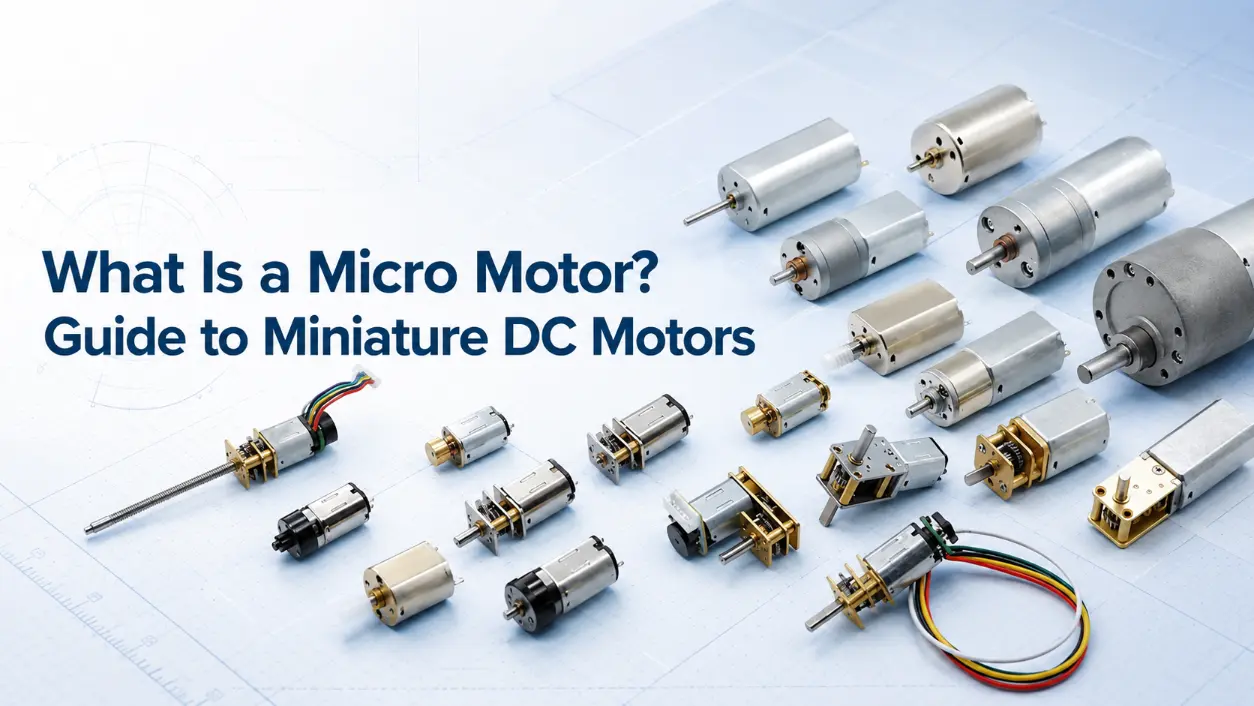
For engineers specifying motion components for compact actuation systems, the micro motor represents a fundamental building block where form factor directly constrains available torque, speed, and service life. A typical micro motor — such as the widely deployed N20 series — measures 12 mm in diameter, yet delivers stall torque figures ranging from 0.8 kg·cm to over 2.5 kg·cm depending on gear reduction and operating voltage. Understanding the electrical, mechanical, and thermal trade‑offs embedded in these miniature DC motors is essential before committing to a supplier or integrating one into a robotics, medical, or automotive actuator design.
Defining the Micro DC Motor
A small DC motor is commonly defined as any brushed or brushless direct‑current rotary machine with a frame diameter under 40 mm and a rated power output typically below 50 W. Within this category, tiny motor designs — those with diameters of 6 mm to 20 mm — are frequently employed in applications where available mounting volume is measured in cubic centimetres. The core electromechanical principle remains identical to that of larger DC electric motor counterparts: a current‑carrying armature interacts with a permanent magnetic field to produce torque. However, the scaling laws governing heat dissipation, brush wear, and gear train integrity shift considerably as envelope dimensions decrease.
Most commercially available micro motors fall into one of two commutation architectures. Brushed DC motors employ mechanical carbon brushes sliding against a segmented copper commutator to switch current direction in the rotor windings. This approach delivers strong starting torque with simple, low‑cost control — typically requiring only a DC power source and a transistor‑based driver. In contrast, brushless DC motors (BLDC) relocate the permanent magnets to the rotor and use an external electronic controller to energise stator windings in sequence. The absence of physical brush contact eliminates a primary wear mechanism, extending operational lifespan from approximately 3 000 hours for a brushed unit to over 10 000 hours for a BLDC equivalent under continuous‑duty conditions. However, the electronic commutation required by a brushless DC motor introduces additional system complexity and component cost that may be prohibitive for high‑volume, cost‑sensitive products.
Key Performance Parameters
Selecting a 12 V DC motor — or any other voltage variant — requires systematic evaluation of four interrelated electrical and mechanical characteristics. The following table summarises the primary specification points that appear on any reputable micro motor datasheet.
| Parameter | Typical Range (Micro DC Motors) | Engineering Significance |
|---|---|---|
| Rated Voltage | 3 V – 24 V DC | Determines compatibility with available power rails; 12 V and 24 V are industrial standards |
| No‑Load Speed | 500 – 20 000 RPM (motor shaft) | Sets maximum theoretical output speed before gearing |
| Stall Torque | 0.5 – 16 kg·cm (geared output) | Indicates maximum torque available at zero speed; gear train integrity limits practical sustained load |
| Stall Current | 0.4 – 3.0 A | Defines peak inrush demand; critical for power supply and driver MOSFET selection |
The relationship between speed and torque in a DC motor high‑torque configuration is approximately linear for brushed permanent‑magnet designs: as load torque increases, rotational speed decreases proportionally until the stall condition is reached. This linearity simplifies control loop design but imposes a practical constraint: operating a micro motor continuously at loads exceeding approximately 25 % of its stall torque accelerates brush wear and raises winding temperature beyond the rated insulation class. For applications demanding sustained high‑torque DC electric motor performance, engineers often specify a higher gear reduction ratio to multiply torque while keeping the motor itself operating within its efficient, low‑current region.
Voltage Selection and Speed‑Torque Scaling
Voltage directly influences both no‑load speed and available torque in a small DC electric motor. At reduced supply voltage — for example, operating a 6 V rated motor at 3 V — the no‑load speed and stall torque both scale approximately linearly with the voltage ratio. A Pololu N20 motor specified with 2.0 kg·cm stall torque and 220 RPM free‑run speed at 6 V delivers approximately 1.0 kg·cm and 110 RPM when powered from a 3 V source. This scaling behaviour allows a single motor platform to serve multiple voltage domains within a product family, provided the driver circuitry and thermal management are designed for the lowest expected operating voltage.
Common voltage tiers in the micro motor market include 3 V DC motor and 5 V DC motor variants for battery‑operated consumer devices, 6 V DC motor configurations for educational robotics platforms, and 12 V DC motor or 24 V DC motor options for industrial and automotive actuators. A 12‑volt DC motor remains the most frequently specified voltage for general‑purpose miniature actuation, balancing power delivery with the availability of off‑the‑shelf 12 V power supplies and battery packs.
Torque, Speed, and Gear Reduction
The apparent contradiction between high‑speed DC motor requirements and high‑torque DC motor demands is resolved through mechanical gear reduction. A micro motor’s raw rotor speed — often 10 000 to 20 000 RPM — is reduced by a planetary or spur gear train to a usable output speed, typically in the range of 30 to 1 000 RPM. This reduction multiplies torque by approximately the gear ratio, minus efficiency losses that typically range from 10 % to 30 % depending on the number of stages and gear material.
For instance, the widely used N20 micro gear motor platform offers reduction ratios from 5:1 to over 1 000:1. A 12 V N20 variant with a 298:1 ratio delivers a no‑load output speed of 100 RPM with a rated torque of 2.00 kg·cm and a stall torque of 16.00 kg·cm. Such a small gear motor is suitable for driving linear actuators, valve mechanisms, or robotic gripper fingers where positional holding torque is more critical than traversal speed. Conversely, a 5:1 ratio high‑speed DC motor configuration on the same N20 frame produces 6 800 RPM no‑load speed but offers only 0.09 kg·cm of extrapolated stall torque — adequate for fan impellers or high‑speed spindle applications but unsuitable for load‑bearing actuation.
Encoder Integration for Closed‑Loop Control
Open‑loop speed control of a DC motor is sufficient for many basic applications, but position‑critical systems — such as robotic joints, camera gimbals, or automated test equipment — require feedback. A DC motor with encoder incorporates a magnetic or optical incremental encoder that generates pulse trains proportional to shaft rotation. Hall‑effect encoders, commonly integrated into micro metal gearmotor assemblies, provide two‑channel quadrature output that enables both speed measurement and direction detection.
The encoder resolution, expressed as counts per revolution of the motor shaft, multiplies through the gear reduction to produce extremely fine positional feedback at the output shaft. A 14‑pole magnetic ring (equivalent to 7 pole pairs) combined with a 150:1 gearbox, for example, can yield over 2 000 pulses per output revolution. This resolution supports PID velocity control loops and odometry calculations in small DC motor‑based mobile robots. However, specifying a motor with built‑in encoder increases both unit cost and wiring complexity — trade‑offs that must be evaluated against the application’s precision requirements.
Common Micro Motor Families and Applications
Several motor frame sizes have become de facto industry standards, each optimised for a specific power and envelope. The following families are listed in order of increasing frame diameter.
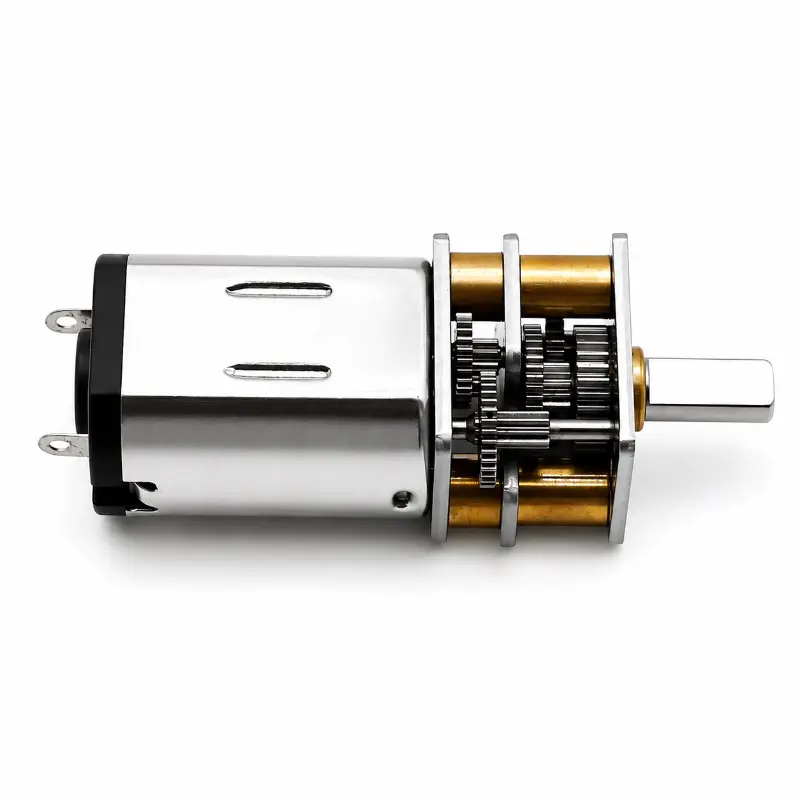
The N20 motor family — characterised by a 12 mm diameter, all‑metal gearbox construction, and availability with or without integrated encoders — is perhaps the most ubiquitous miniature gear motor in the hobbyist and light‑industrial segments. Typical N20 configurations operate from 3 V to 12 V, with output speeds ranging from 20 RPM to over 1 000 RPM depending on the gear ratio. Common applications include small DC motor‑driven camera pan‑tilt mechanisms, micro linear actuator 12 V assemblies for consumer electronics, and differential‑drive motors for robotics platforms.
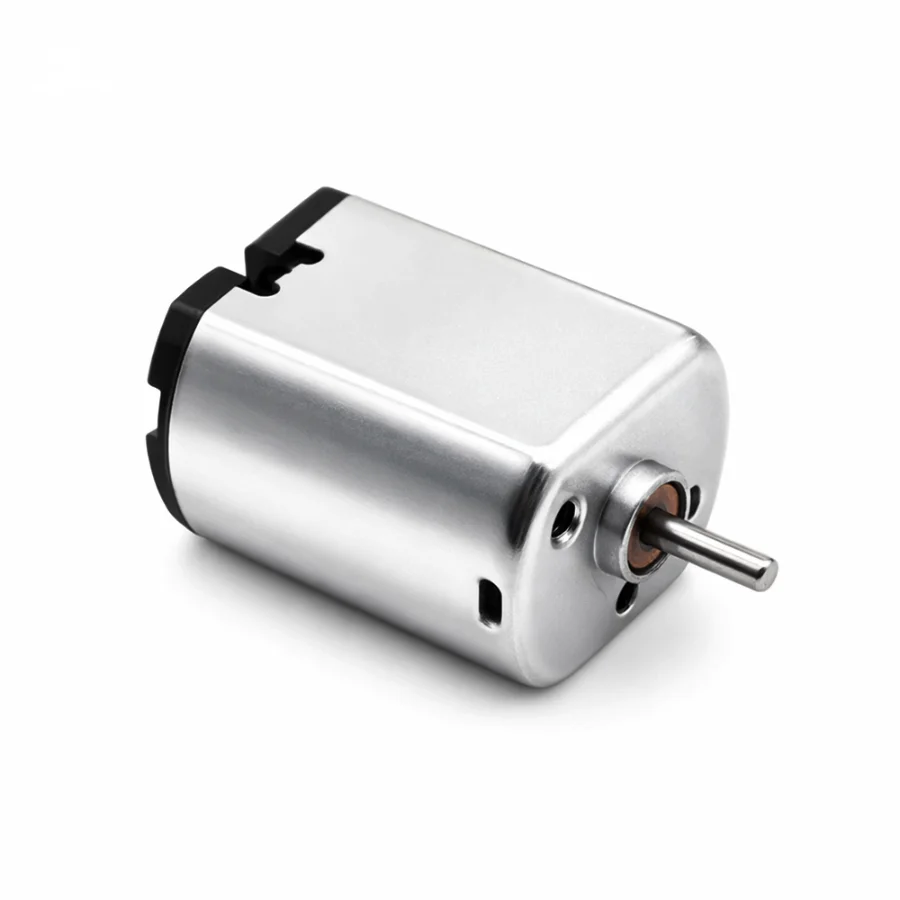
At the smaller end of the spectrum, the 030 micro DC motor (16 mm diameter) and the 130 motor (approximately 20 mm diameter) families are commonly found in vibrating alert mechanisms for wearables and handheld devices. Both are typically brushed, low‑power designs that operate from 1.5 V to 6 V, with no‑load speeds ranging from 5 000 to 15 000 RPM. Their primary function is haptic feedback rather than rotary actuation, and they are specified by vibration amplitude rather than torque output.
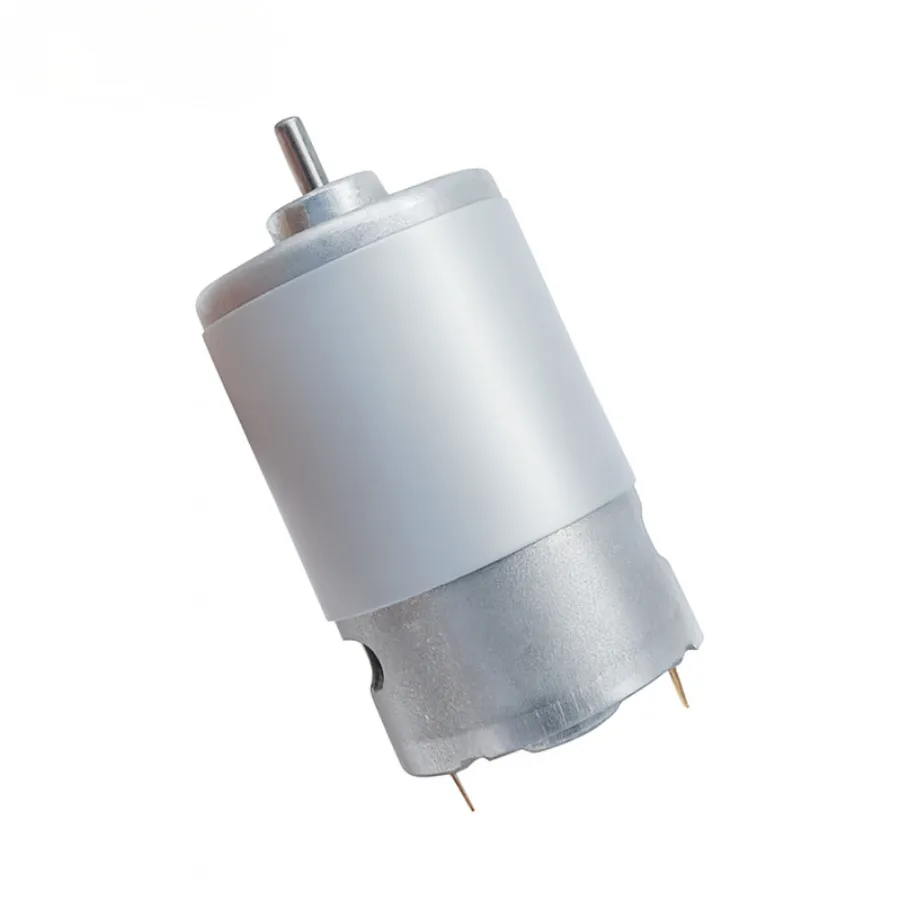
The 555 DC motor family — typically featuring a 36 mm to 38 mm diameter, brushed construction, and operating voltages from 3 V to 24 V — occupies the mid‑power segment between the miniature N20 and the larger 775 frame sizes. A typical RS‑555 variant delivers no‑load speeds from 3 000 to over 20 000 RPM with power ratings up to 50 W, making it suitable for handheld power tools, automotive actuator assemblies, and consumer appliance drives. While the 775 motor offers higher output power for demanding loads such as scooter drives, the 555 platform provides a balanced trade‑off between torque capability and mounting envelope for applications where the larger 775 diameter is prohibitive.
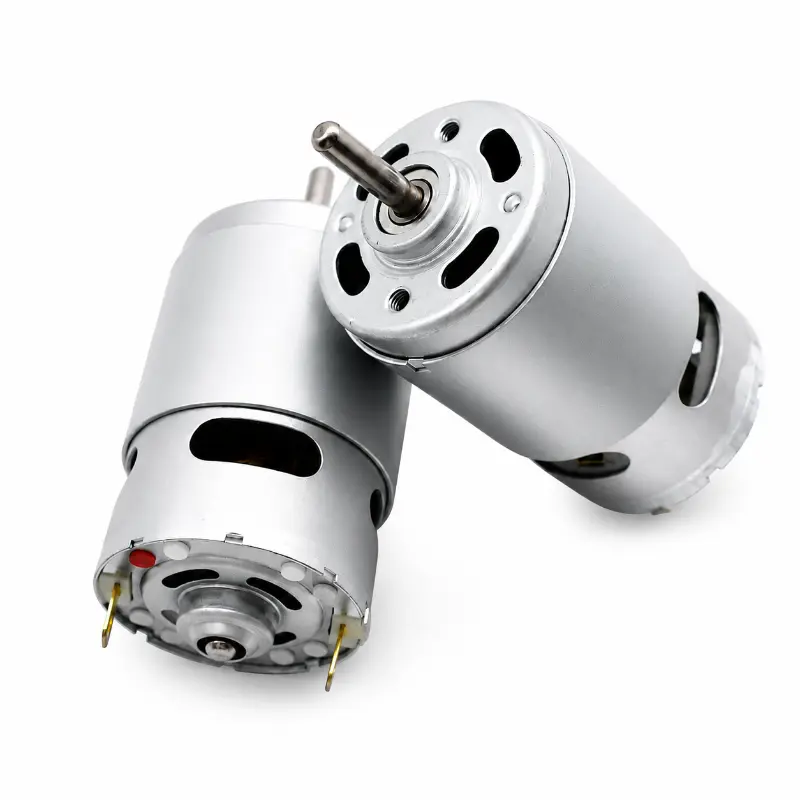
The 775 DC motor represents a larger form factor — approximately 42 mm in diameter (with some variants up to 44.5 mm including magnetic rings) — that bridges the gap between micro motors and full‑sized industrial machines. A 12 V 775 motor typically delivers 3 000 to 6 000 RPM no‑load speed (with certain high‑speed variants reaching up to 20 000 RPM) and torque ratings from 2 to 5 kg·cm. These small electric motors are frequently specified for power tool upgrades, electric scooter drives, and high‑speed fan applications where the larger frame diameter is acceptable in exchange for higher output power.
For applications requiring sustained low‑speed operation without external gearing, low‑RPM DC motor designs with integrated worm or planetary gearboxes provide direct‑drive torque multiplication. A DC motor low‑RPM configuration with a 1 000:1 reduction ratio can produce output speeds below 10 RPM while delivering stall torque exceeding 10 kg·cm from a package no larger than a AA battery. Such low‑speed high‑torque motors are used in solar tracker actuators, automated window openers, and precision positioning stages.
Vibration Motors and Specialty Variants
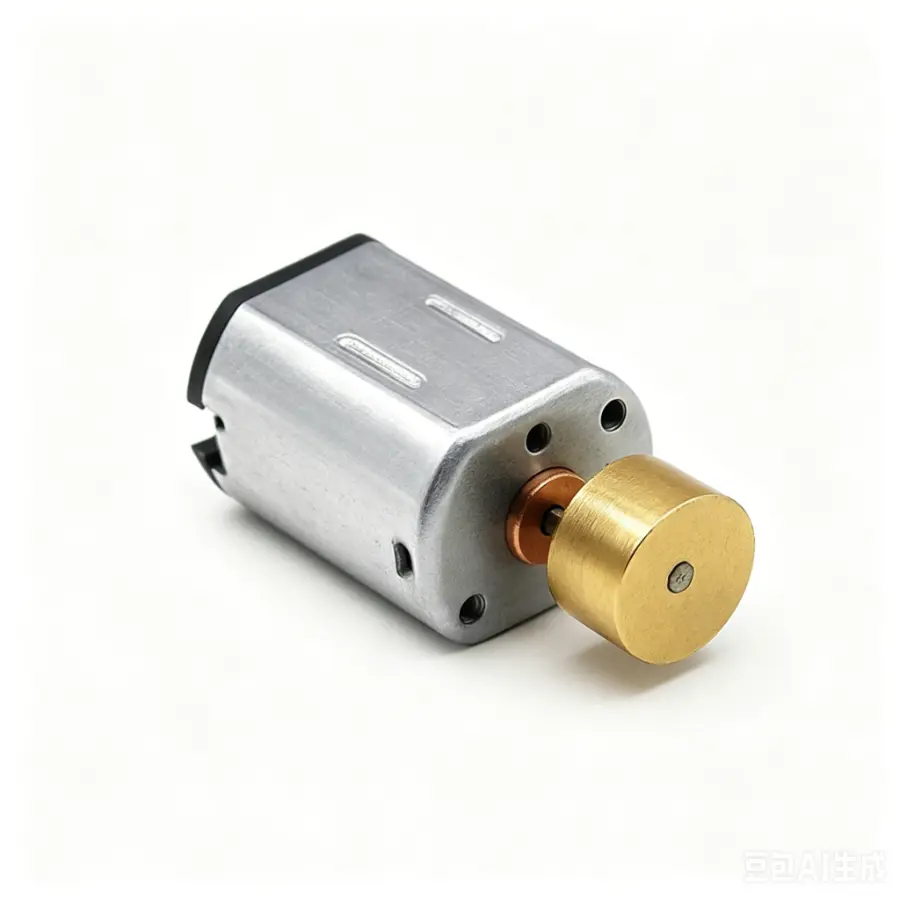
Beyond rotary actuation, the small vibrating motor category encompasses eccentric rotating mass (ERM) and linear resonant actuator (LRA) designs. A 12 V vibration motor with an offset mass attached to the rotor shaft generates perceptible haptic feedback in medical devices, gaming controllers, and industrial alert systems. These vibrating motors are typically specified by vibration amplitude (measured in G‑force) rather than torque, and their operating current — often 50–200 mA — must be accommodated by the driver stage.
Procurement Considerations for Volume Production
For engineering teams transitioning from prototype to production, sourcing micro DC motor components at commercial scale introduces supplier qualification and consistency requirements beyond those of hobbyist channels. The majority of the global micro DC motor manufacturing capacity is concentrated in China, with major industrial clusters in Shenzhen, Dongguan, and Yuyao. Micro DC motor manufacturers in these regions typically offer ISO 9001 and ISO 14001 certifications, supporting OEM and ODM engagements for custom shaft geometries, lead wire terminations, and gear ratios.
When evaluating micro DC motor suppliers, critical documentation includes the motor’s speed‑torque curve, thermal derating characteristics, and expected brush life under the intended duty cycle. A small DC motor rated for intermittent operation — such as 10 % duty cycle — will exhibit significantly different thermal behaviour than one specified for continuous rotation at 100 % duty. Engineers should request sample lots of at least 10 units to characterise mechanical runout, starting voltage variation, and acoustic noise before committing to bulk micro DC motor procurement.
Customisation options available from China‑based micro DC motor suppliers include output shaft profiles (round, D‑shaft, or threaded), integrated encoder mounting, and specialised winding configurations for higher or lower operating voltages. Wholesale micro DC motor pricing typically decreases with order volume, with discounts becoming more favourable above 1 000 units; further reductions are often negotiable for annual supply agreements. However, the lowest unit price does not always correlate with the lowest total cost of ownership — field failure rates and batch‑to‑batch consistency must be factored into the supplier selection process.
Conclusion
The micro motor category encompasses a diverse range of miniature DC motors unified by their sub‑40 mm frame diameters and reliance on permanent‑magnet DC excitation, with performance defined by the interdependent parameters of voltage, speed, torque, and gear reduction — each of which must be matched to the specific load profile, duty cycle, and thermal environment of the target application.