

Micro Motor Blogs
Micro DC Motor Selection Guide: Top FAQs Answered
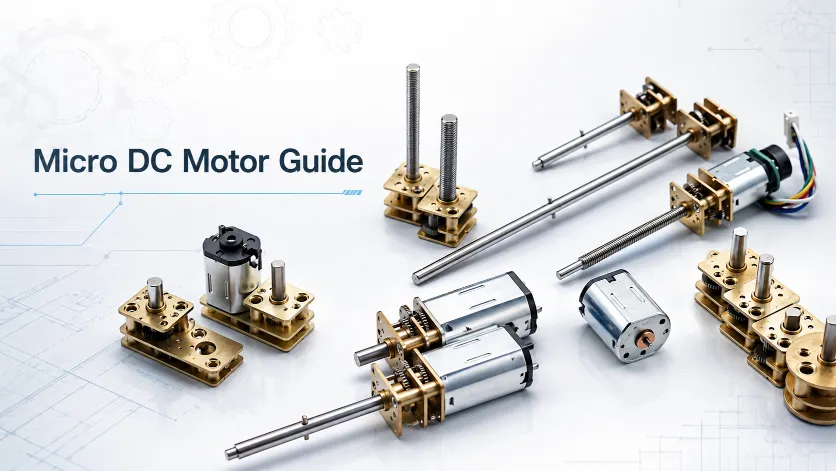
Finding the right micro DC motor for a project is rarely a quick yes-or-no decision. Most engineers ask the same few questions over and over: What torque do I actually need? How much voltage should I run? Is brushed or brushless the better choice for my application? And perhaps the most common question of all: why does this motor stall every time I put it under load?
This guide answers the most frequently asked questions about micro DC motor selection—without the fluff. Whether you are designing a robotic actuator, a medical pump, or a smart lock mechanism, you will find practical answers here. Let’s get straight into the questions that matter.
Understanding Motor Types – Which One Do I Need?
1. How do brushed, brushless, and coreless micro DC motors differ?
Brushed DC motors are the simplest option. Apply DC voltage or PWM through an H‑bridge, and you get controllable speed and bidirectional torque. They are inexpensive and widely available, making them a solid choice for cost-sensitive designs. The trade-off is brush wear and electrical noise—brushes create EMI that needs to be filtered at the system level.
Brushless DC motors (BLDC) use electronic commutation instead of mechanical brushes. They run more quietly, last much longer, and require less maintenance. If your design demands long life and high efficiency in a compact package, BLDC is where you should be looking.
Coreless DC motors remove the iron core from the rotor. This design lowers inertia, giving you faster response times and higher efficiency. They are excellent for applications that need quick acceleration and precise control.
2. What is the most direct difference between brushed and brushless motors when selecting one?
The decision usually comes down to two things: lifetime and control complexity.
If you need basic variable speed control and your duty cycle is intermittent, a brushed motor will work fine and keep your BOM cost low. If your application runs continuously or demands high reliability—think medical devices, drones, or industrial automation—brushless motors are the better choice.
Also consider EMI. Brushed motors generate significant electrical noise from brush arcing. Brushless motors produce less EMI because they lack mechanical brushes, but their PWM drives still generate some electrical noise. For very sensitive analog circuits, you may need filtering regardless of motor type.
Matching Parameters – Voltage, Speed, Torque, Current
3. How are voltage, speed, torque, and current related in a micro DC motor?
Three rules cover most of what you need to know:
- Speed is proportional to supply voltage
- Torque is proportional to motor current
- For constant voltage operation, speed and torque have an inverse relationship—higher torque means lower speed
These relationships are linear in most micro DC motors, which makes selection more predictable than it might seem.
4. Which parameter should I look at first when selecting a micro DC motor?
Start with voltage. This is usually the most limiting factor—what power supply is actually available in your system?
Once voltage is fixed, look at physical size constraints. Micro DC motors typically run from 1.5 V up to 48 V, with common options at 3 V, 6 V, 12 V, and 24 V. Your battery configuration or system power rail will narrow down the choices significantly. After voltage and size are determined, then you can match torque and speed to your load requirements.
5. How do I choose the right rated voltage for my device?
The general principle is straightforward: choose a motor rated at or slightly above your available supply voltage. Running a motor below its rated voltage reduces torque output. Running it above rated voltage risks overheating and burnout.
For battery-powered devices, the real-world voltage sags as batteries discharge. If your device uses lithium-ion batteries (fully charged at 8.4 V, empty around 6 V), selecting a motor rated at 7.2 V or using a 12 V motor with derating keeps performance consistent across the battery’s operating range.
6. What is the difference between no-load speed and load speed?
No-load speed is how fast the motor spins when nothing is attached to the shaft. Load speed is the actual operating speed when the motor is doing real work under load. Load speed is always lower than no-load speed because the motor draws more current to overcome resistance, which slows it down.
When you look at a motor datasheet, the no-load speed tells you the motor’s potential. The load speed tells you what it will actually do in your application. Always design around the load speed.
Calculation and Sizing – Making the Numbers Work
7. How much torque do I need, and how do I calculate it?
Torque requirements depend entirely on your load. The starting torque must overcome inertia from a standstill. Running torque keeps the load moving once it is already in motion.
The most common formula for calculating motor torque is:
Use this to calculate how much torque a motor can deliver, or to determine what torque your application actually needs.
For micro DC motors, torque is often specified in mNm or g·cm. If you are using a gearmotor, remember that the gearbox multiplies output torque by the reduction ratio—but output speed decreases by the same factor. Keep a safety margin of 20–30% above your calculated required torque to handle unexpected load spikes.
8. How do I determine power requirements, and how much margin should I leave?
First, calculate the mechanical power your application needs:
The conventional approach is to select a motor whose maximum output power is 1.5 to 2 times the calculated mechanical power. This margin accounts for inefficiencies, temperature effects, and manufacturing tolerances.
For example, if your application needs 1.6 W of mechanical power at the shaft, look for a motor rated for roughly 2.4–3.2 W maximum output power.
9. How do I balance torque, speed, and efficiency in a micro DC motor?
This is where most of the trade-offs happen. A DC motor produces maximum mechanical power when operating at half of its no-load speed and half of its stall torque. But maximum power is not where the motor runs most efficiently.
The most efficient operating point is typically around 90% of no-load speed and 10–30% of stall torque, though these figures vary by motor design. Always consult the datasheet efficiency curve for your specific model. In practice, you will rarely operate at maximum power because thermal constraints become limiting. The highest efficiency is achieved at high speed, which is worth remembering if battery life is a primary concern.
10. How do I know if a motor can handle continuous operation?
The major constraint on motor operation is thermal in nature. Heat is the real limiter, not torque or speed.
For continuous-duty operation, the required speed should be higher than half the no‑load speed at nominal voltage, and the load torque should be less than half the stall torque. Straying outside these ranges accelerates wear and risks overheating.
If your motor runs too hot to touch comfortably, you are probably exceeding its thermal limits. Datasheets usually specify maximum coil temperature—typically 155°C for coreless motors—and thermal resistance from coil to ambient. Using these values, you can calculate steady‑state temperature rise:
I = T / Kt
P = I2 × R
If the calculated coil temperature exceeds the datasheet maximum, the motor is not suitable for continuous operation at that load.
11. How important is current limit in motor selection?
It is more important than most engineers realize. Stall current—the current drawn when the motor is prevented from rotating—is typically 5 to 10 times the rated current, sometimes higher in very small motors. Your motor driver circuit must be able to handle this peak without failing.
Current also determines torque. The relationship is linear: torque = Kt × (I − I0), where Kt is the torque constant and I0 is no‑load current. If your power supply cannot deliver the required current, the motor will not produce the torque you expect.
12. What is the role of a gearbox, and when should I use one?
A gearbox reduces output speed while multiplying output torque by the gear reduction ratio. This is essential when you need high force at low RPM—think robotic joints, smart locks, or payment terminal mechanisms.
The rule of thumb when using gearing: select the motor for the minimum speed practical, choosing a motor with a higher voltage rating than your available supply. This results in lower noise and better life characteristics.
A planetary gear motor, in particular, offers superior efficiency, higher torque density, and excellent durability in a compact package. When you do need the most demanding torque and smooth operation, a planetary gearbox paired with a micro motor is the premium solution.
Application Questions – From Robotics to Medical Devices
13. Which motor types work best for robotics, medical devices, and consumer electronics?
Each application has different priorities:
- Robotics: High torque at low RPM is usually the goal. Planetary gear motors are common here. For arms and grippers that need precise movement, BLDC or coreless motors with encoders work well.
- Medical devices: Reliability and precision matter most. Brushless motors are preferred for devices like infusion pumps and surgical instruments. Low noise is also critical in medical environments.
- Consumer electronics: Cost often drives the decision. Brushed motors appear in smart locks, small actuators, and compact pumps where duty cycles are intermittent.
14. Why do many robotics projects favor high‑torque low‑RPM configurations?
Because robots need to move and hold loads against gravity or resistance. A high‑torque, low‑RPM motor can produce significant rotational force while operating at slower speeds, which provides finer, more precise control.
Think of a robotic arm joint. If you run the motor at high speed and rely on a gearbox to reduce RPM and multiply torque, you get the holding force you need. Without that torque, the arm would sag or fail to lift its payload.
Motors with Gearboxes – What You Need to Know
15. How does a gearbox change torque and speed in a micro DC motor?
When you add a gearbox, output torque multiplies by the gear reduction ratio, and output speed divides by the same ratio—minus small friction losses in the gear train.
For example, if your motor produces 10 mNm of torque at 10,000 RPM, a 50:1 planetary gearbox will give you roughly 500 mNm of output torque at 200 RPM. The actual output will be slightly lower due to gearbox efficiency, which is typically 70–90% depending on gear type.
16. How do I avoid under‑sizing a gearmotor so it cannot turn the load at all?
The most common mistake is calculating required torque at the motor shaft but forgetting that the gearbox multiplies current as well as torque. Current is what determines torque. When you run a motor through a gearbox, the motor sees the reflected load torque divided by the reduction ratio—not the output torque you need.
Always work backward from the load: calculate the output torque you need at the gearbox output shaft, then divide by the reduction ratio and gearbox efficiency to find the torque the motor must deliver. Add a safety margin of 20–30%. If the result exceeds the motor’s rated torque, you either need a larger motor or a different gear ratio.
17. How do I choose between N20 and N30 gearmotors?
N20 and N30 are form‑factor shorthand, not strict technical standards. They tell you roughly what size and torque capability to expect.
- N20: About 10×12 mm cross-section. Low to medium torque, medium to high speed. Common in smart locks, small actuators, compact pumps, and tiny gearmotor modules.
- N30: Shares the same 10×12 mm cross-section as N20 but has a longer body and higher torque capacity. Suited for higher load actuators, latch and drive mechanisms, and compact industrial modules.
N30 motors have more copper volume than N20, which generally means higher torque capability for similar speeds. If your space allows the longer body, N30 is the safer choice for torque‑sensitive designs.
Selection Checklist and Practical Tips
| Checkpoint | What to verify |
|---|---|
| Voltage | What supply is available? Match rated voltage or stay slightly above |
| Size | What diameter, length, and shaft type fit your enclosure? |
| Torque | Starting torque + running torque + 20–30% margin |
| Speed | Required output speed at the load—not motor no‑load speed |
| Duty cycle | Continuous or intermittent? Lower duty allows smaller motors |
| Driver | Can your driver handle stall current (typically 5–10× rated)? |
| Environment | Temperature, noise limits, and EMI requirements |
| Gearbox | Does the application need torque multiplication at low RPM? |
Conclusion
The right micro DC motor selection process is not a guessing game. It is a step‑by‑step workflow: define your voltage and size constraints first, then match torque and speed to your load requirements, and finally apply the gearbox if you need high torque at low RPM.
If you still have questions after working through this guide, your best next step is to reach out to a motor supplier with your application parameters. A good supplier will help you interpret your operating point against their datasheet curves and recommend a motor that fits your mechanical, electrical, and thermal constraints.
One last piece of advice: never trust the no‑load speed as your operating speed. Always test with a representative load before finalizing your design. That is where the real answers live.