

Micro Motor Blogs
High Torque in Small Spaces: Engineering Advantages of Planetary Gear Stepper Motors
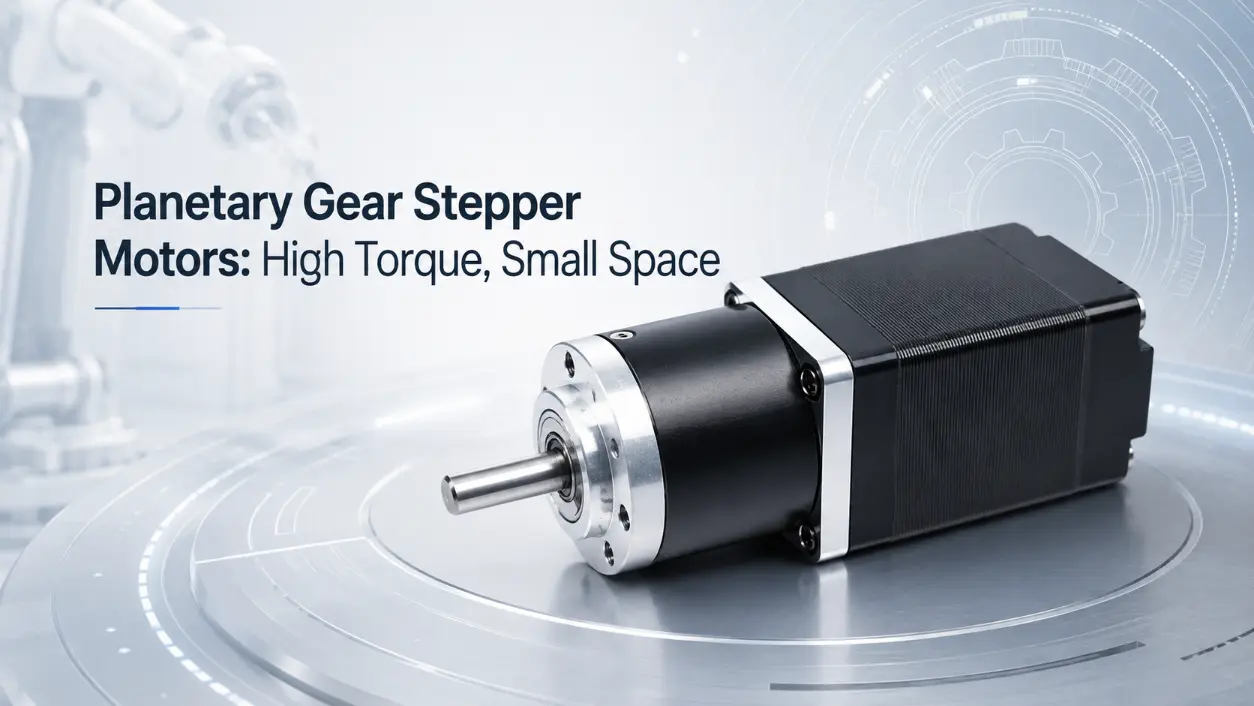
Modern mechanical systems often require high torque output within limited installation spaces. Direct-drive stepper motors may lack sufficient holding torque or exceed dimensional constraints. Integrating a planetary gearhead with a stepper motor, known as a planetary gear stepper motor, multiplies output torque while maintaining coaxial alignment. This configuration is widely used in automation, medical devices, and robotics.
Anatomy and Mechanics of Planetary Gearheads
A planetary gearhead consists of four primary mechanical elements: a central sun gear, multiple planetary gears, an outer internal ring gear, and a carrier that supports the planets and transmits the output torque. When the stepper motor shaft drives the sun gear, it rotates the planetary gears, which orbit the sun while meshing with the fixed ring gear. This configuration distributes transmitted loads across multiple tooth contacts, reducing stress concentration compared to traditional spur gears. The carrier integrates the planetary axes and delivers the reduced‑speed, high‑torque output.
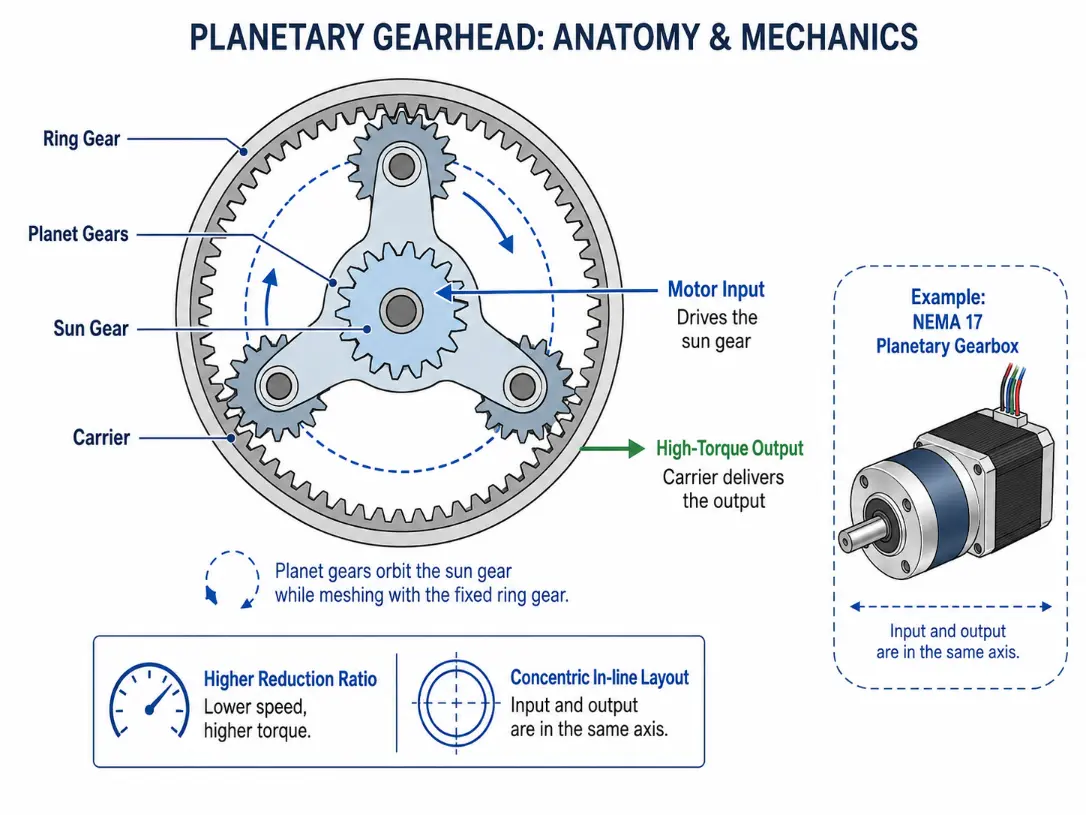
The multi‑tooth engagement allows high reduction ratios in a concentric, in‑line layout. For instance, integrating a nema 17 planetary gearbox enables an actuator to increase output torque without shifting the output shaft centerline, preserving alignment with downstream mechanical components.
Core Engineering Advantages
Torque Density
A standard stepper motor is limited by its rotor volume and magnetic saturation. Increasing holding torque typically requires a larger frame size, which conflicts with spatial constraints. By adding a reduction gearhead, the output torque is multiplied by the gear ratio and reduced by frictional losses. Planetary gear efficiencies typically range from 70% to 95%, depending on the number of stages, lubrication, and operating conditions. For example, a 5:1 reduction with 90% efficiency yields an effective torque multiplication of 4.5. This allows a smaller motor, such as a nema 8 stepper motor paired with a micro‑gearhead, to deliver torque comparable to a much larger direct‑drive unit, making it suitable for micro‑adjustment stages and other space‑limited applications.
Backlash Control
Positional errors during direction reversals often arise from mechanical play (backlash) between gear teeth. Precision‑engineered planetary gear assemblies minimize this clearance through tight tolerancing of tooth profiles and the use of preloaded bearings. However, a small amount of backlash is typically necessary to accommodate lubrication, thermal expansion, and long‑term wear. Many precision planetary gearboxes achieve backlash values below 3 arcminutes, and some high‑end designs can reach below 1 arcminute. This ensures that the step resolution of the underlying stepper motor translates accurately to the output shaft, maintaining repeatability under alternating loads.
Mechanical Stiffness
Industrial actuators often encounter combined radial and axial loads from belt tension, lead screw thrust, or off‑center payloads. While planetary gear configurations offer good structural rigidity, the load capacity is primarily determined by the output bearing arrangement rather than the load sharing among planets. Many planetary gearheads integrate cross‑roller or angular‑contact bearings to support high radial and axial loads. The planets primarily transmit torque, while the carrier and output shaft bearings manage external forces. Proper bearing selection is critical for achieving the required stiffness and service life.
Application Scenarios
Miniaturized motion control with high torque density finds use in several industries:
Medical Equipment
Diagnostic analyzers, automated pipetting systems, and surgical robots require precise, low‑speed fluid handling and positioning. Planetary gear stepper motors provide the necessary torque to drive pumps against fluid resistance while maintaining low noise and thermal stability.
CNC and 3D Printing
Extruder drives and axis positioning systems benefit from consistent filament feeding pressure and stable linear motion. Geared stepper motors prevent filament slippage during rapid retraction while keeping the print head assembly lightweight.
Gimbal and Camera Systems
Camera gimbals require high holding torque to counteract gravitational forces during tilt and pan movements. Small gearmotors provide the necessary torque without adding excessive weight.
Selecting the Appropriate Frame Size
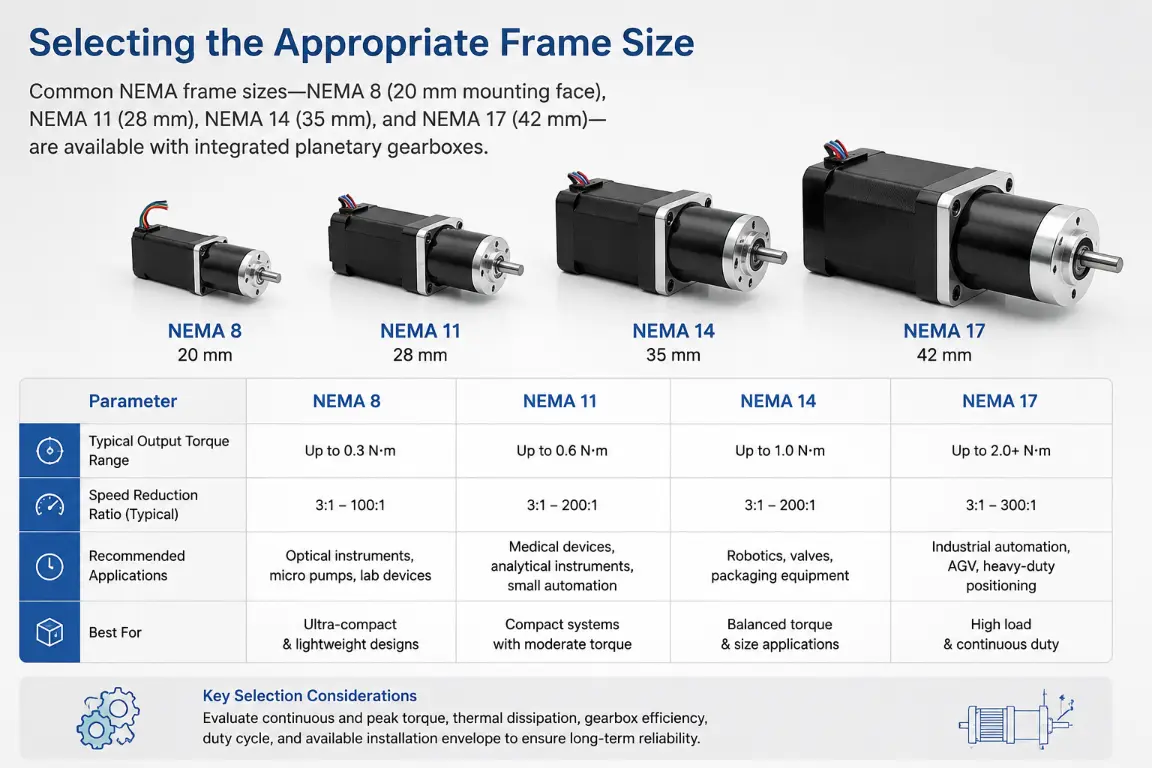
Common NEMA frame sizes—NEMA 8 (20 mm mounting face), NEMA 11 (28 mm), NEMA 14 (35 mm), and NEMA 17 (42 mm)—are available with integrated planetary gearboxes. The selection depends on required output torque, speed reduction ratio, duty cycle, and available envelope. For example, NEMA 8 planetary gearboxes are suitable for ultra‑compact instruments, while NEMA 17 planetary gearboxes serve heavier automation tasks. Designers should evaluate continuous and peak torque, thermal dissipation, and gearbox efficiency to match the application demands.
Conclusion
Planetary gear stepper motors offer an optimized balance between spatial constraints and mechanical output. By understanding the mechanics, torque multiplication, backlash behavior, and stiffness characteristics, engineers can effectively apply these actuators in demanding, space‑limited systems.
Frequently Asked Questions
The motor’s electrical step angle remains unchanged, but the output resolution improves by the gear reduction ratio. For example, a 1.8° step motor with a 5:1 gearbox produces 0.36° per full step at the output, enhancing positioning resolution.
Internal friction in the gearbox generates additional heat. The motor winding insulation is typically rated to Class B (130°C) or higher, while the gearhead may tolerate higher temperatures, but the interface transfers heat. Engineers must calculate duty cycles and consider forced cooling or reduced current to prevent exceeding the motor’s rated temperature.