

Micro Motor Blogs
Sourcing Tips: Partnering with a Bespoke Micro DC Motor Factory China
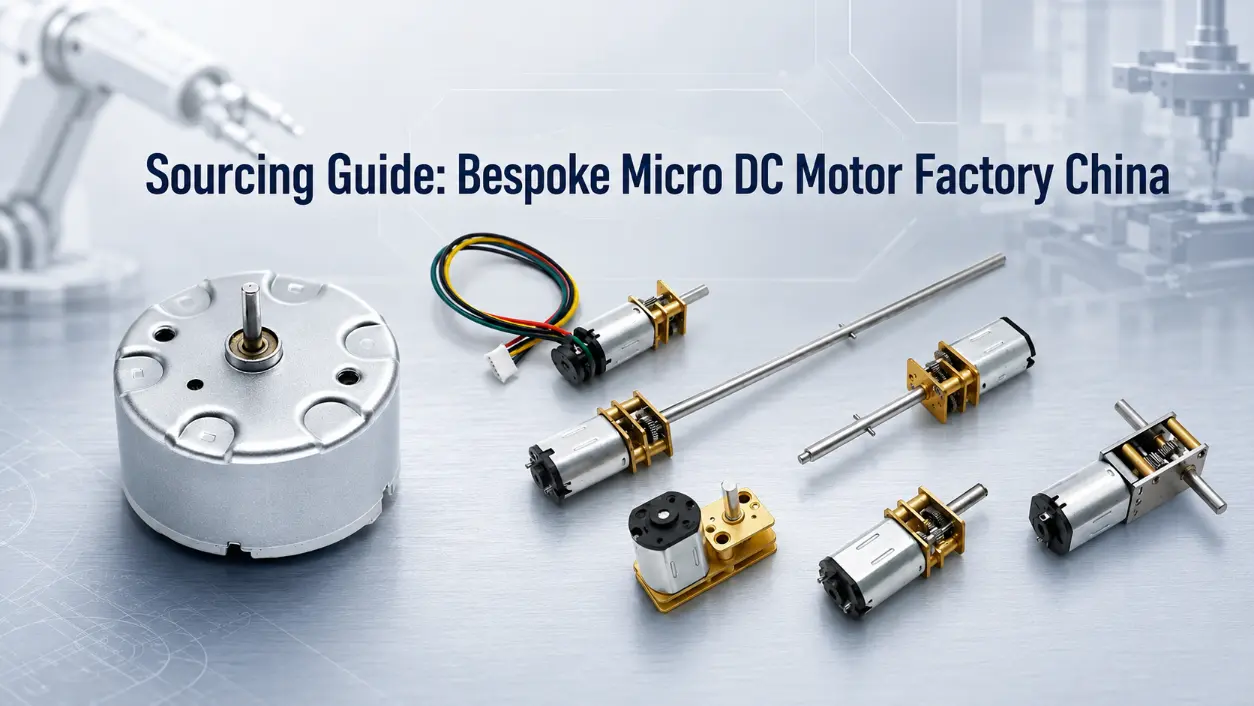
In the high-precision sectors of robotics, medical instrumentation, and industrial automation, the demand for non-standardized actuation components has reached an unprecedented scale. Engineers and procurement managers frequently encounter performance bottlenecks when relying on off-the-shelf components that fail to meet specific thermal constraints, torque-speed curves, or spatial integration requirements. Engaging a bespoke micro DC motor factory China provides the engineering agility necessary to align component performance with precise application demands. Identifying a partner capable of executing complex technical specifications—rather than simply fulfilling standard catalog orders—is essential to mitigate supply chain risks and ensure product longevity in demanding operational environments.
The Strategic Value of Partnering with a China Micro DC Motor Supplier
The domestic manufacturing ecosystem in China has evolved beyond simple assembly, maturing into a sophisticated hub for motor engineering and precision machining. When sourcing a china micro dc motor, procurement teams often gain access to integrated production lines that encompass magnetics design, winding technology, and automated shaft precision engineering—though the degree of vertical integration varies among suppliers, and careful due diligence is recommended to verify actual capabilities.
For industrial applications requiring specific duty cycles or high-volume deployment, sourcing through a wholesale micro dc motor model can allow for significant cost optimization without compromising structural integrity, provided that the supplier maintains consistent quality controls. By streamlining the supply chain—from raw material sourcing (such as high-grade rare earth magnets and copper alloys) to finished motor assembly—well-established China-based facilities provide a quantifiable advantage in both unit cost and delivery speed. This integration is particularly vital for project timelines where long lead times for prototype iterations can jeopardize market entry schedules.
Technical Criteria for Evaluating a Micro DC Motor Manufacturer
Selecting an appropriate micro dc motor manufacturer requires a systematic assessment of technical competencies rather than relying solely on pricing models. Engineers should adopt a structured approach to filter potential suppliers, recognizing that not all factories offer the same level of engineering support or quality assurance.
Evaluating Partner Competency
When determining how to choose a custom micro DC motor partner, technical leadership should assess the following pillars:
- Design for Manufacturing (DFM) Capability: Can the supplier translate theoretical motor performance into mass-producible designs? A competent factory will provide feedback on tolerances, material selection, and potential failure modes early in the design phase.
- Quality Management Systems: Ensure the facility maintains current certifications (e.g., ISO 9001:2015, IATF 16949). These standards indicate that the factory possesses the infrastructure for rigorous environmental testing, such as vibration analysis and accelerated life testing under thermal stress.
- Verification Infrastructure: A reliable manufacturer should have in-house equipment to validate parameters such as back-EMF constants, cogging torque, and radial shaft play. On-site audits or third-party inspections can help confirm these capabilities.
Standardized Comparison of Motor Technologies
| Specification | Brushed Micro DC Motor | Brushless Micro DC Motor (BLDC) |
|---|---|---|
| Commutation | Mechanical (Carbon Brushes) | Electronic (Hall Effect/Sensorless) |
| Operational Life | Limited by brush wear | High (Bearing life limited) |
| Efficiency | Moderate | High (optimized thermal profile) |
| Control Complexity | Low (Voltage dependent) | High (Requires drive electronics) |
| Maintenance | Periodic brush replacement | Maintenance-free |
The Custom Development Lifecycle
The engineering phase for a bespoke motor is a collaborative process that demands clear communication between the client’s R&D team and the factory’s technical lead. A practical custom micro DC motor design guide for engineers typically follows a sequential verification process:
- Specification Definition: Clearly document operating voltage ranges, nominal torque, peak current limits, and environmental conditions (IP rating).
- Preliminary DFM Review: The factory evaluates physical constraints—this may involve custom shaft lengths, unique gearhead ratios, or integration of optical encoders.
- Prototype Development: A small-batch run is produced. Engineers should perform dynamic load testing to verify that the motor’s heat dissipation correlates with the thermal model designed in the CAD phase.
- Mass Production Validation (PPAP): Before full-scale deployment, a production part approval process ensures the repeatability of the manufacturing process, specifically regarding consistent coil winding and magnetic flux density across batches.
Comparative Analysis: Brushed vs. Brushless Architectures
When weighing the advantages of brushless vs brushed micro DC motors, the decision should be driven by the duty cycle and the total cost of ownership.
Brushed motors remain a viable, cost-effective solution for short-term or intermittent-use devices—such as certain household actuators or simple fluid pump systems—where control circuitry must remain rudimentary. Conversely, brushless motors are engineered for high-reliability, continuous-duty applications. They utilize electronic commutation to eliminate brush friction, which can substantially reduce EMI (Electromagnetic Interference) and increase the mean time between failures (MTBF). For precision applications in medical diagnostic equipment or flight control surfaces in UAVs, the brushless architecture is often preferred due to its superior efficiency and ability to sustain high RPMs without thermal degradation, though the final selection should always align with specific application requirements and budget constraints.
Conclusion
Partnering with a specialized bespoke micro DC motor factory China allows for the precise integration of custom electromechanical components, ensuring that motor performance is calibrated to the specific load requirements of the application rather than forced into generic specifications. A thorough evaluation of technical capabilities, quality systems, and prototyping agility—combined with realistic expectations regarding MOQ and lead times—will help procurement and engineering teams build a sustainable supply chain partnership.
FAQ: Common Technical Inquiries
What are the typical minimum order quantities (MOQ) for custom motor projects?
MOQs for bespoke designs are generally higher than for standard catalog items due to the tooling costs for customized end caps, shafts, or windings. Many specialized facilities require an initial run in the range of several hundred to a few thousand units to effectively amortize setup and verification costs, though some suppliers may offer lower MOQs for pilot batches at a higher per-unit price. It is advisable to discuss MOQ flexibility early in the negotiation phase.
How do you ensure that a custom motor design meets international safety and environmental regulations?
A professional manufacturer should provide a Technical Construction File (TCF) detailing compliance with RoHS and REACH standards. For motors destined for medical or aerospace applications, the supplier must demonstrate capability in traceability for all raw materials and undergo third-party auditing to meet specific regional standards like CE or UL certifications. Requesting these documents and verifying them with recognized testing bodies is a prudent practice.
Why is prototype iteration time critical in the design phase?
Prototyping is the stage where theoretical simulations meet physical realities, such as friction losses in gear trains or magnetic saturation in the core. A short iteration cycle allows for rapid adjustments in magnet material or winding gauge, reducing the risk of costly engineering changes once the hard tooling for mass production has been finalized. Collaborating with a factory that offers responsive engineering support during this phase can significantly shorten time-to-market.