

Micro Motor Blogs
Why Metal Gear Motors Outperform Plastic Gearboxes in Harsh Environments
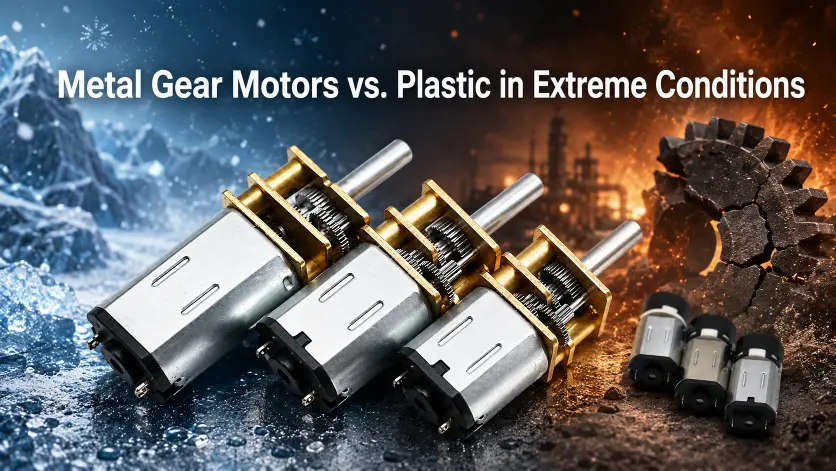
Selecting the appropriate power transmission assembly for industrial automation, automotive actuators, and outdoor valve control requires balancing upfront component costs against long-term operational durability. Polymeric gearheads, typically molded from polyoxymethylene (POM) or nylon, are frequently selected for light-duty applications due to low unit cost and minimal acoustic noise. However, when deployed in aggressive operating environments characterized by severe thermal fluctuation, mechanical shock loads, and high continuous torque demands, polymer gearing degrades rapidly through tooth shear, thermal softening, and cold flow deformation. Engineered metal gear motors provide the structural rigidity, elevated yield strength, and efficient thermal dissipation required for demanding industrial duty cycles.
Structural Integrity of Metal Gear Motors Under Heavy Mechanical Load
Mechanical power transmission under cyclic stress requires gear tooth materials capable of withstanding continuous bending fatigue and high contact pressure without structural failure. Gear teeth fabricated from sintered powdered metals, cut carbon steel, or brass alloys exhibit tensile yield strengths substantially higher than unreinforced or glass-filled polymers. The inherent structural advantages offered by metal gear motors become evident when evaluating component behavior under high mechanical stress.
Tooth Shear Resistance and Fatigue Behavior
Under continuous operational load, the pitch line of a meshing gear tooth encounters repetitive contact pressure. Polymeric gears subjected to high contact pressure undergo elastic deformation. This structural deflection alters the nominal meshing center distance and shifts the load vector toward the tip of the gear tooth, increasing the bending moment at the root fillet. Under sustained torque, this stress concentration leads to micro-cracking and ultimate tooth shear. In contrast, hardened steel and sintered alloy tooth profiles maintain precise geometry under high contact pressure, distributing stress uniformly across the active tooth face width.
Impact of Shock Loading and Stall Conditions
Industrial machinery routinely encounters sudden resistive loads, mechanical jams, or rapid motor reversals. When a system stalls, the rotational kinetic energy of the motor armature converts into an instantaneous torque spike at the gearhead output stage. In plastic gearboxes, this energy spike frequently exceeds the tensile yield limit of the polymer, resulting in immediate tooth stripping. A small dc gear motor built with an all-metal spur or planetary gear train absorbs these transient energy spikes through higher material impact toughness. For heavy-duty linear positioning or motorized valve actuation where a 12v dc motor high torque drive is specified, metallic gearing ensures that unexpected overload events do not cause sudden gear train failure.
Thermal Dissipation and Environmental Resistance in Metal Gear Motors
Operating environments characterized by temperature extremes or chemical exposure severely limit the functional lifespan of non-metallic gear trains. Efficient thermal management within the gear housing is critical to preventing mechanical failure.
Thermal Conductivity and Heat Management
Electrical losses (I²R) within motor copper windings generate significant heat during continuous operation. In an enclosed drive assembly, this thermal energy must conduct through the gear train and housing to dissipate into the surrounding environment. Polymers exhibit low thermal conductivity (typically 0.2 to 0.4 W/m·K), effectively trapping heat inside the internal gear chamber. As internal ambient temperatures approach the glass transition temperature (Tg) of the polymer, the material’s elastic modulus drops, reducing mechanical strength significantly at temperatures exceeding 80°C.
Metallic gear materials—such as steel, bronze, and aluminum—possess thermal conductivity values ranging from 15 to over 200 W/m·K. This enables metal gear motors to transfer heat away from internal friction points and motor armatures, preventing localized thermal softening and maintaining mechanical strength across operating temperatures ranging from -40°C to over 150°C.
Environmental and Chemical Resistance
Polymeric materials absorb moisture and various industrial solvents over time, resulting in volumetric swelling that degrades operating clearances and alters backlash tolerances. In contrast, a miniature gear motor utilizing brass or stainless steel gearing maintains exact dimensional tolerances when exposed to high humidity, synthetic lubricants, or industrial chemicals. In heavy-duty applications powered by a 24v high torque dc motor, such as outdoor security barriers or agricultural automation mechanisms, metallic gear construction prevents environmental degradation and housing distortion.
Operational Dynamics and Efficiency in Metal Gear Motors
Maintaining consistent power transmission efficiency over thousands of operational hours requires tight machining tolerances and minimal mechanical compliance.
Precision Mesh Geometry and Backlash Stability
Circumferential backlash (jt) defines the clearance between meshing gear teeth. In precision positioning mechanisms, uncontrolled backlash causes positional drift, mechanical oscillation, and non-uniform velocity transmission. In a micro gear motor, microscopic deflection of polymer shaft bores under continuous load can lead to center-distance enlargement. This structural flexibility increases backlash over time. Metallic gear plates and hardened shaft journals maintain center-distance tolerances within tight specifications, retaining precise gear tooth engagement over extended operating lifespans.
Torque Amplification and Speed Reduction Dynamics
Speed reduction gearheads rely on precise reduction ratios to convert high input shaft RPM into usable output torque. The initial stage connected directly to the motor shaft operates at high angular velocity, while the final output stage carries the maximum mechanical moment. A micro motor driving a metallic multi-stage gearbox handles this mechanical gradient effectively: high-velocity input stages resist surface wear, while high-torque output stages resist tooth bending. When configured as a low rpm dc motor for heavy industrial equipment, metal gear trains transmit steady rotational torque without internal tooth slip or compliance losses.
Total Cost of Ownership and B2B Selection Criteria
Evaluating power transmission components purely on initial unit purchase price ignores the long-term financial impact of field failures.
Initial Component Cost vs. Field Reliability
While plastic gearboxes present a lower initial bill-of-materials cost, their susceptibility to sudden field failure introduces substantial commercial risk. Replacing a failed gearhead in an installed industrial system involves field technician labor, machine downtime, warranty administrative expenses, and potential damage to brand reputation. Selecting metal gear motors increases initial component expenditure but lowers the Total Cost of Ownership (TCO) by reducing gear tooth fatigue as a primary point of system failure.
Total Cost of Ownership (TCO) Comparison over Equipment Lifecycle
[ Plastic Gearbox Option ]
- Initial BOM Cost: Low
- Field Replacement Frequency: High (Labor + Downtime + Warranty Claims)
- Overall TCO: Elevated & Less Predictable
[ Metal Gearhead Option ]
- Initial BOM Cost: Moderate
- Field Replacement Frequency: Significantly Lower (Durable metallic tooth profiles)
- Overall TCO: Lower & More Predictable
Technical Integration Checklist
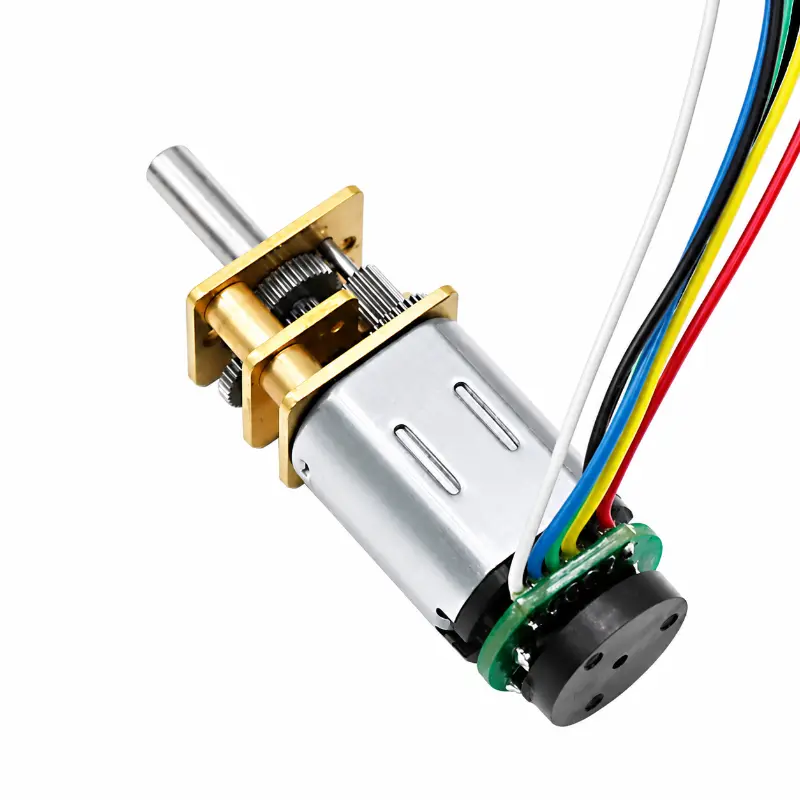
When specifying a small dc gear motor or micro dc motor for industrial systems, design engineers should review the following technical parameters:
- Duty Cycle and Load Profile: Differentiating continuous operation from intermittent duty cycles to select appropriate gear material hardness and heat treatment.
- Radial and Axial Load Ratings: Verifying maximum permissible radial load (Fr) and axial load (Fa) on the output shaft to prevent premature journal bearing failure.
- Ambient Thermal Conditions: Matching internal grease viscosity and shaft oil seal materials to the expected operating temperature range.
- Gear Architecture: Choosing spur gearheads for maximum stage efficiency or planetary gearheads for high torque density within compact spatial envelopes.
Summary and Technical FAQs
For industrial power transmission systems operating under severe load, thermal stress, or aggressive environmental conditions, engineered metal gear motors remain the preferred choice for delivering consistent torque output and extended operational life.
Frequently Asked Questions
Q1: How do lubrication requirements differ between metal gear trains and polymer gear trains?
Polymeric gears often operate unlubricated or with light synthetic grease due to low inherent surface friction. In contrast, metal gear trains require dedicated grease formulations containing extreme pressure (EP) additives such as molybdenum disulfide or synthetic esters. Proper lubrication maintains a boundary oil film between meshing metallic gear teeth, minimizing adhesive wear and reducing operational frictional heat.
Q2: How can acoustic noise be managed when deploying metal gear motors in noise-sensitive equipment?
While metallic gears exhibit higher stiffness than polymers, acoustic emissions can be controlled through precision manufacturing methods. Utilizing ground tooth profiles, helical gear stage geometry, and high-viscosity synthetic damping greases reduces acoustic output significantly while retaining full metallic mechanical strength.
Q3: Are hybrid gear trains (plastic input stage, metal output stage) suitable for harsh environments?
Hybrid gear trains use polymer gears at the high-speed input stage to minimize noise and metal gears at the high-torque output stage to withstand load. While effective in mild indoor environments, hybrid configurations may face challenges in harsh environments due to thermal expansion mismatches between polymer and metal stages, as well as reduced chemical resistance at the polymer input stage. For critical harsh-environment applications, all-metal gear trains remain the more reliable option.