

Micro Motor Blogs
Performance Optimization of Custom 12V Micro Brushed DC Motor in Automation
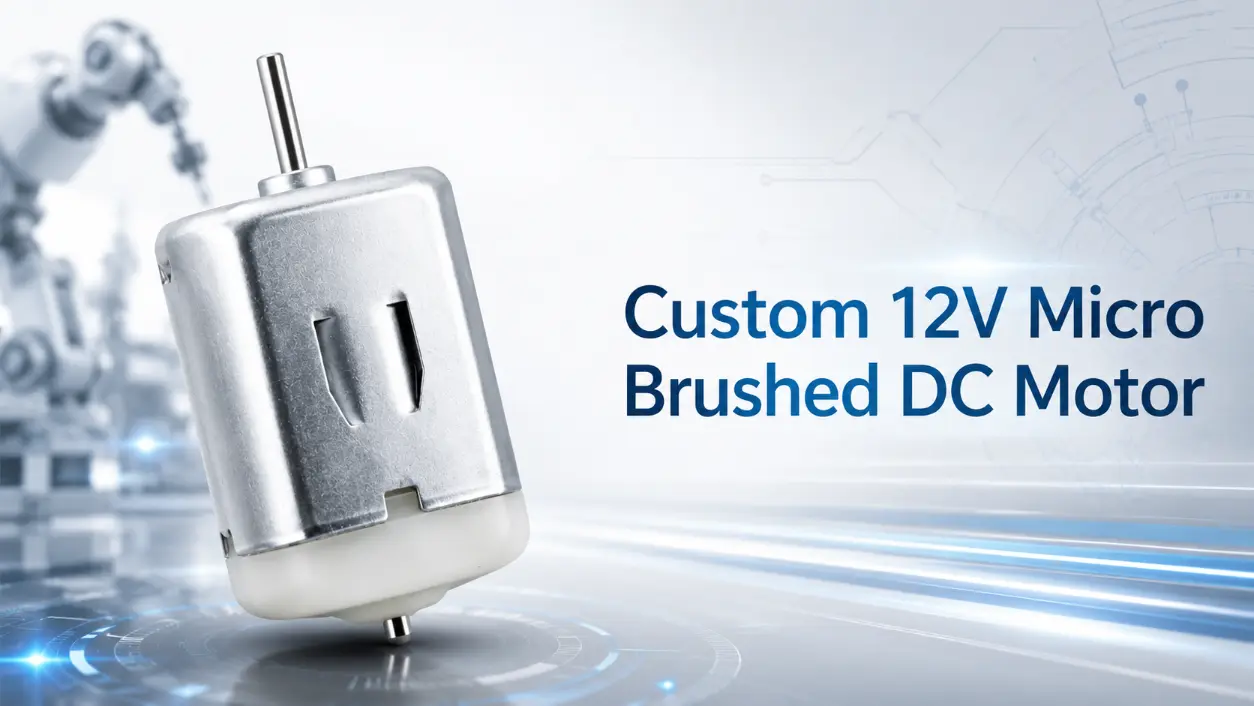
In precision instrumentation and automated machinery, the actuator choice directly influences system reliability and operational lifespan. A custom 12V micro brushed DC motor serves as the motion backbone for many industrial tasks, offering a high power-to-weight ratio while remaining compatible with standard 12V power rails common in laboratory, automotive, and robotic setups. Unlike generic off-the-shelf units, a custom design enables precise tailoring of torque‑speed characteristics, electrical constants, and physical dimensions to meet specific load and environmental demands, thereby preventing premature failures and ensuring consistent performance in space‑constrained applications.
The Foundation: Why Customization Matters
Standard motors often lack the flexibility required for specialised environments, leading to issues such as thermal overheating, insufficient startup torque, or incompatible mounting footprints. Consulting a custom micro DC motor design guide for engineers during the initial phase helps mitigate these variables. Customisation bridges the gap between theoretical requirements and physical limitations. For instance, balancing voltage, current draw, and duty cycle determines motor longevity. A 12V design must optimise coil resistance against magnetic flux density; rapid acceleration favours low rotor inertia, while continuous operation demands enhanced thermal dissipation within the housing. By fine‑tuning these parameters, engineers keep the motor within its optimal efficiency window, reducing heat generation and energy waste.
Engineering for Specific Performance Metrics
Achieving a high speed low noise micro DC motor configuration requires careful attention to commutation and bearing selection. Noise in brushed motors originates from mechanical friction (bearings, brush contact) and electrical sparks during commutation. Material selection is paramount: carbon brushes are durable and suit high‑current applications, while precious‑metal brushes offer low and stable contact resistance, benefiting low‑current, low‑noise scenarios. However, the choice is not binary—factors such as required lifetime, cost, and motor size (e.g., miniature motors below 13 mm often use precious metals, whereas larger ones above 30 mm favour carbon) must be weighed. Additionally, reducing rotor inertia—via hollow‑core designs or specialised windings—enables rapid acceleration with minimal vibration, which would otherwise fatigue the housing and adjacent structures.
Application‑Specific Design Challenges
Engineers must adapt the motor’s internal design to the physical and environmental stresses of the target application.
Robotics and High‑Torque Requirements
When developing a small high torque DC motor for robotics, the primary trade‑off lies between stator magnet strength and armature turns. More turns increase torque at lower speeds but raise resistance; high‑grade permanent magnets compensate for flux reduction, sustaining the torque needed for joint actuators without excessive heat. This tailored approach prevents the inefficiencies of oversized, under‑utilised standard motors.
Automotive Actuators
A custom micro electric motor for automotive actuators faces thermal cycling (−40 °C to +125 °C) and high‑frequency vibration. The internal design must accommodate expansion and contraction via specialised winding varnish and vibration‑resistant solder joints. Customisation ensures that mounting footprints, shaft geometries, and connector types integrate seamlessly with existing vehicle harnesses and chassis interfaces.
Medical Device Precision
Conversely, a micro dc motor for medical devices demands exceptional consistency and sterilisation compatibility. Applications like surgical robotics or infusion pumps focus on reducing cogging torque for smooth motion. While optimising stator tooth geometry and air gap helps, many high‑end medical motors adopt slotless (coreless) designs that inherently eliminate cogging. Materials must also resist corrosion from ethylene oxide or autoclaving, requiring specialised housing alloys.
Mechanical Integration and Transmission Optimization
Mechanical integration often causes premature failure. The motor shaft must transmit torque efficiently—either directly or through a reduction mechanism. When using miniature electric motors with gearbox assemblies, the gear ratio should be selected based on the motor’s peak efficiency point, not its peak power. Planetary gearboxes are preferred for high torque due to load distribution across multiple teeth, offering high torque density and durability; spur gears are chosen for cost‑sensitive, high‑efficiency applications when loads remain within tooth strength limits.
Transmission losses include friction (bearing and tooth mesh), inertia (resistance to acceleration), and backlash (mechanical play). Typical planetary efficiencies range from 85 % to 90 %, and spur gears from 90 % to 95 %, but these values depend on size, lubrication, and load—they are not fixed. Proper coupling between motor and gearbox is critical; misalignment at the micron level introduces radial loads that accelerate bearing wear and increase noise. Flexible couplings help isolate the motor from these forces, ensuring stable rotational axis throughout its life.
Testing and Validation Protocols
A custom‑engineered motor must undergo rigorous validation to confirm design specifications. Thermal management testing—using thermocouples on the casing and monitoring winding temperature rise—determines the maximum allowable load before insulation degradation. This data establishes the rated duty cycle. Life‑cycle testing simulates expected usage profiles; for example, automotive actuators may undergo millions of start‑stop cycles at varying temperatures to reveal brush wear, lubricant degradation, or insulation breakdown. Quality assurance standards must enforce tight tolerances on electrical resistance, shaft concentricity, and magnetic symmetry to ensure batch‑to‑batch consistency.
Conclusion
The deployment of a custom 12V micro brushed DC motor transforms a generic motion requirement into a purpose‑engineered solution, enabling precise balancing of torque, speed, and thermal performance for modern automation. By moving beyond off‑the‑shelf specifications and focusing on application‑centric design—from robotic torque demands to the noise sensitivity of medical devices—engineers achieve significant gains in system longevity, efficiency, and operational consistency. Success hinges on collaborative alignment between the systems engineering team and the motor manufacturer, ensuring that mechanical and electrical constraints meet the final environmental demands.
Frequently Asked Questions
Why is 12 V the standard voltage for many micro motors if higher voltages are more efficient for power transmission?
In micro‑automation, 12 V is chosen not for transmission efficiency but for compatibility and safety. Most control electronics (MCUs, logic circuits) operate within 5 V to 24 V; a 12 V rail aligns with common power supplies, battery chemistries (e.g., 3S Li‑ion), and automotive standards. This simplifies motor driver integration (H‑bridge) without complex voltage conversion stages that introduce losses and increase component count.
Does increasing the gear ratio of a miniature gearbox always result in higher output torque?
While a higher gear ratio mechanically increases output torque, it is limited by both gear tooth strength and the motor’s available torque. Beyond a certain threshold, the force on gear teeth may cause shearing or plastic deformation. Moreover, each additional stage reduces efficiency due to friction. Furthermore, if the reflected load exceeds the motor’s maximum torque, the motor will stall. Therefore, the goal is to select the lowest ratio that effectively converts motor speed into required output torque, while keeping the motor operating within its high‑efficiency RPM range.