

Micro Motor Blogs
Maximizing Efficiency: Custom Micro Brushless Motor for Drones and UAVs
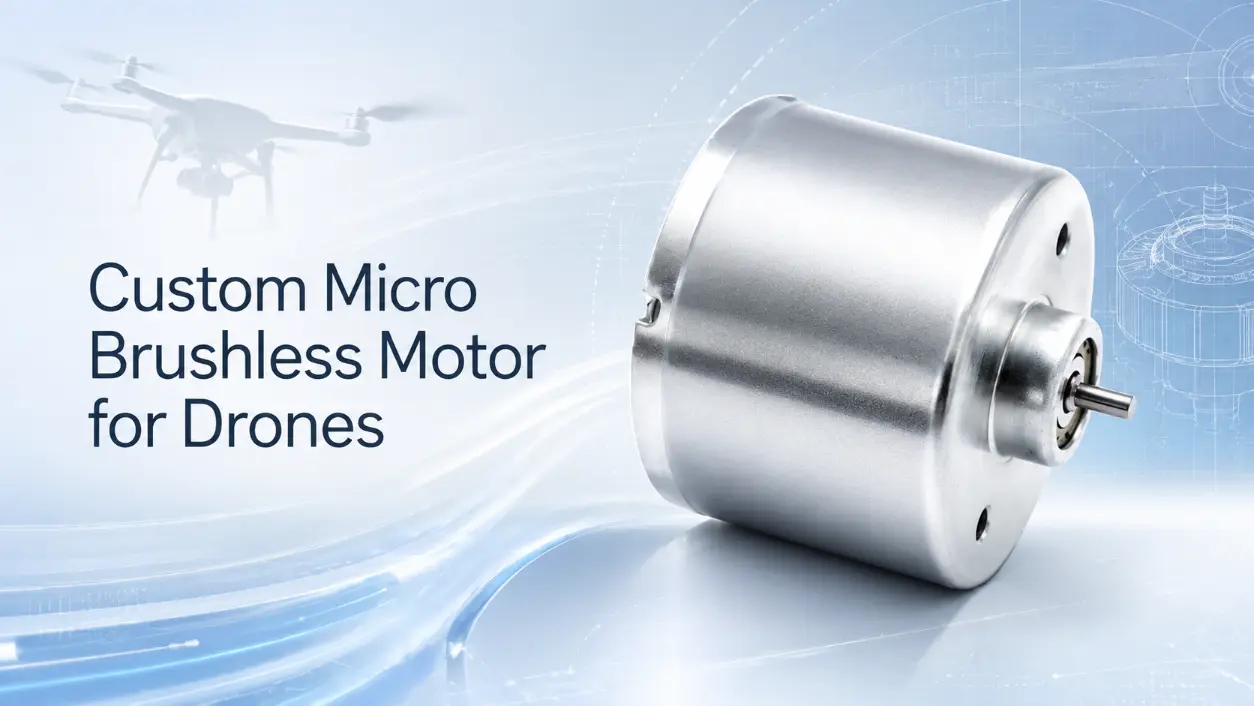
Introduction: Maximizing UAV Performance with a Custom Micro Brushless Motor for Drones
Modern unmanned aerial vehicles (UAVs) demand propulsion systems that are precisely matched to their flight profiles, payloads, and energy sources. While off-the-shelf motors offer convenience, they are often designed for broad applications, which may not align with the specific torque, speed, and thermal requirements of a given drone. Integrating a custom micro brushless motor for drones allows engineering teams to tailor electromagnetic characteristics—such as stator geometry, winding configurations, and magnetic flux density—to reclaim efficiency points that generic components might sacrifice. This targeted approach can extend mission duration and improve overall system reliability, provided that the design process carefully balances performance gains against development costs and lead times.
The Propulsion Challenge in Modern UAV Engineering
The primary obstacle in micro-UAV propulsion is the inherent trade‑off between power density and thermal management. Standard motors are built for high‑volume markets, and while many perform adequately across a range of loads, they may operate outside their peak efficiency zone when integrated into specialised airframes with unusual propeller sizes or confined cooling paths. This mismatch often manifests as increased heat generation, which accelerates insulation ageing and can cause thermal drift in sensitive avionics. Vibration control is equally critical; a high speed low noise micro DC motor design is essential for surveillance and inspection drones, where inertial measurement units (IMU) and optical sensors rely on stable mounting surfaces. High‑frequency vibrations—originating from rotor imbalance or magnetic cogging—can introduce noise into the control loop and degrade flight stability. Mitigating these issues requires careful motor selection, and sometimes customisation, but it is important to note that many standard motors can be successfully matched with appropriate propellers and ESCs, avoiding unnecessary customisation costs.
Navigating the Supply Chain: Partnering with an OEM Miniature DC Motor Supplier
When transitioning from prototype to production, the choice of manufacturing partner is as vital as the motor design itself. An experienced OEM miniature DC motor supplier provides access to validated processes—endurance testing, material certifications, and quality management systems—that are rarely available from generic distributors. For engineering teams seeking cost‑effective customisation, a bespoke micro DC motor factory China can offer a practical pathway. Modern facilities employ advanced CNC winding equipment and automated dynamic balancing stations, enabling precise control over winding tension and rotor symmetry. Working with such a factory allows engineers to adjust mechanical interfaces—shaft diameter, mounting hole patterns, or bearing types—during the design phase, rather than forcing the airframe to adapt. This synergy reduces the need for heavy adapters, contributing to mass reduction. However, customisation typically involves higher non‑recurring engineering (NRE) costs, longer lead times (often 16–30 weeks), and minimum order quantities, so the total cost of ownership should be evaluated against the performance benefits.
Custom Micro DC Motor Design Guide for Engineers
A systematic approach is essential to realise the full potential of a tailored motor. This custom micro DC motor design guide for engineers outlines the core parameters that must be defined before finalising specifications with a manufacturer.
Key Design Parameters
When specifying a custom motor, engineers must clearly define physical dimensions, KV rating, maximum current, and thermal limits to ensure compatibility with the electronic speed controller (ESC) and battery management system (BMS). The air‑gap clearance between rotor and stator deserves particular attention: reducing this gap enhances magnetic coupling and efficiency, but demands tighter manufacturing tolerances to prevent mechanical contact under thermal expansion or high‑G manoeuvres. Additionally, the choice of magnet grade (e.g., N52SH for high‑temperature resistance) and stator lamination material (thin silicon steel to minimise eddy‑current losses) directly influences performance. It is wise to involve the manufacturer early in the design stage to assess feasibility and cost implications, as some desired specifications may require exotic materials or advanced winding patterns that significantly increase unit price.
Torque–Speed Characteristics at Different Voltages
Typical performance curves for a custom micro brushless motor
Selection Process: How to Choose a Custom Micro DC Motor
Understanding how to choose a custom micro DC motor begins with a thorough analysis of the drone’s operational envelope. The following steps can guide the decision‑making process:
1. Define the Duty Cycle: Determine the proportion of flight time spent in hover versus cruise. A motor optimised for static thrust may not be ideal for high‑speed forward flight, where different torque and speed profiles prevail.
2. Analyse Torque Requirements: Calculate the required torque based on propeller inertia and aerodynamic drag. For aggressive manoeuvring or heavy payloads, prioritise high torque density over raw rotational speed.
3. Evaluate Thermal Behaviour: Assess the drone’s housing and cooling airflow. If the motor is enclosed, the manufacturer must employ high‑temperature insulation coatings on magnet wire to prevent short‑circuits during prolonged high‑load segments. Thermal simulation or real‑world testing is strongly recommended.
4. Validate Fit and Integration: Request prototype samples to verify mechanical fitment, wire exit paths, and connector compatibility. Ensure that the assembly does not obstruct cooling vents or add undue stress to the airframe.
Remember that a higher KV rating does not automatically translate to better efficiency; it changes the torque‑speed characteristic. Matching KV to the propeller load and battery voltage is far more critical than chasing a large number.
Beyond Drones: Scalability and Cross‑Application
The engineering principles applied to UAV propulsion are highly transferable. For instance, the high power‑to‑weight ratio demanded by drone motors is equally beneficial in robotics. A small high torque DC motor for robotics often shares similar design challenges—precise positional control, compact integration, and low‑latency response. By leveraging the same design methodology (optimising winding resistance and magnetic circuits), engineers can adapt motor platforms for robotic grippers, actuators, or miniaturised camera gimbals. This cross‑application approach can help achieve economies of scale, as the same custom motor platform may serve multiple functions within a larger product line, reducing overall per‑unit costs when volumes are sufficient.
Conclusion
Maximising drone efficiency often requires moving beyond generic components toward purpose‑built electromagnetic solutions. A custom micro brushless motor for drones offers the ability to fine‑tune stator geometry, magnetic flux, and thermal pathways to match specific operational demands. Yet, this decision should be weighed against the added costs, development time, and minimum order quantities. By carefully defining requirements, collaborating with a reputable OEM miniature DC motor supplier or bespoke micro DC motor factory China, and validating prototypes thoroughly, engineering teams can achieve propulsion systems that deliver measurable gains in endurance, reliability, and flight performance—while keeping the project commercially viable.