

Micro Motor Blogs
High Torque Solutions: Designing a Miniature DC Gear Motor for Smart Locks
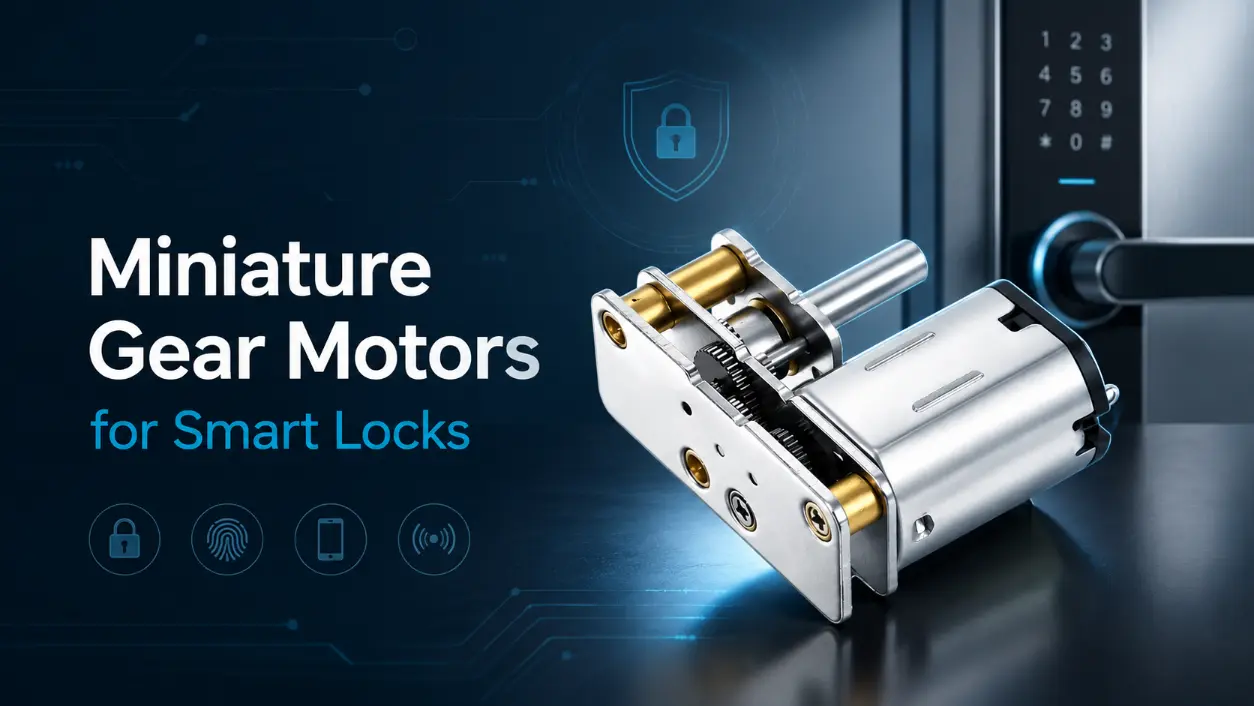
Modern smart lock designs demand a careful balance between mechanical output and spatial constraints. The core actuation element is a miniature DC gear motor for smart locks, which must deliver sufficient torque to drive a deadbolt while operating within a slim enclosure and consuming minimal battery power. Although high‑torque, low‑RPM performance is essential, the path to achieving it does not always require fully custom engineering – a point often overlooked in vendor marketing.
Engineering Challenges in Smart Lock Actuation
The fundamental conflict remains unchanged: high physical output from an extremely limited volume. A standard bare motor runs at high speed with low torque, which is inadequate for directly driving a lock bolt against misalignment or frame swelling. However, the industry has long solved this by pairing standard motors with integrated gearheads. Off‑the‑shelf high torque micro DC motor low RPM combinations (e.g., N20‑series gear motors) are widely used and proven reliable in thousands of commercial products. The key is to select a motor with appropriate winding resistance and magnetic circuit design, not to automatically jump to a bespoke solution.
Standard vs. Custom: A Reality Check
While some articles insist that only a custom micro DC motor manufacturer can provide adequate performance, the truth is more nuanced. For the vast majority of smart lock applications, standard catalog motors meet both torque and efficiency targets when paired with a suitable planetary gearbox. Typical torque requirements for a deadbolt range from 1.0 to 2.0 kg·cm, and many standard products comfortably deliver that at currents below 400 mA under load. Customisation becomes valuable only when the lock must operate in extreme temperatures, requires a non‑standard output shaft (e.g., D‑cut or splined), or demands an unusual form factor. Thus, engineers should treat customisation as a second‑tier option, not the default.
Gearbox Integration: Why Planetary Arrangements Excel
When high torque density is required, a custom planetary gear micro DC motor offers the best mechanical efficiency. Planetary gears distribute load over multiple teeth simultaneously, reducing wear and preventing binding during the high‑load portion of the stroke. This architecture is inherently compact and can achieve reduction ratios of 100:1 or more within the same envelope as a spur‑gear box. For engineers developing new lock platforms, including planetary gearing in the initial design – whether from a standard catalogue or a tailored variant – is a sound practice. It is the topology itself that matters more than the “custom” label.
How to Choose and Where to Buy
For those who genuinely need a tailored solution, a custom micro DC motor design guide for engineers should start with a thorough duty‑cycle analysis: define the peak torque, operating frequency, ambient conditions, and expected cycle life (typically >10,000 cycles). This data allows you to specify winding turns, magnet strength, and gear materials. When evaluating suppliers, ask for detailed torque‑speed‑current curves, not just catalogue averages. As for how to choose a custom micro DC motor, prioritise vendors that offer in‑house manufacturing of both the motor core and the gearhead – this ensures tighter tolerances on shaft runout and housing alignment, which directly affect bearing life and acoustic noise. For practical procurement, where to buy customized miniature gear motors involves contacting established motion‑control houses (e.g., Keshuo, or specialised Asian manufacturers) that have proven experience in security applications. Always request samples and verify performance with your own load fixture.
Conclusion: Balanced Engineering Wins
In summary, the decision to use a standard or a miniature DC gear motor for smart locks should be driven by objective technical requirements, not by marketing hype. Standard planetary‑gear motors are capable and cost‑effective for most designs; customisation adds value only when specific environmental or mechanical constraints cannot be met off‑the‑shelf. By following a data‑driven selection process – defining load cycles, requesting performance curves, and validating prototypes – engineers can achieve reliable, long‑lasting lock actuation without over‑engineering or over‑spending. The optimal solution is always the simplest one that meets all specifications.