

Micro Motor Blogs
What Engineers Should Check Before Choosing a High Speed DC Motor
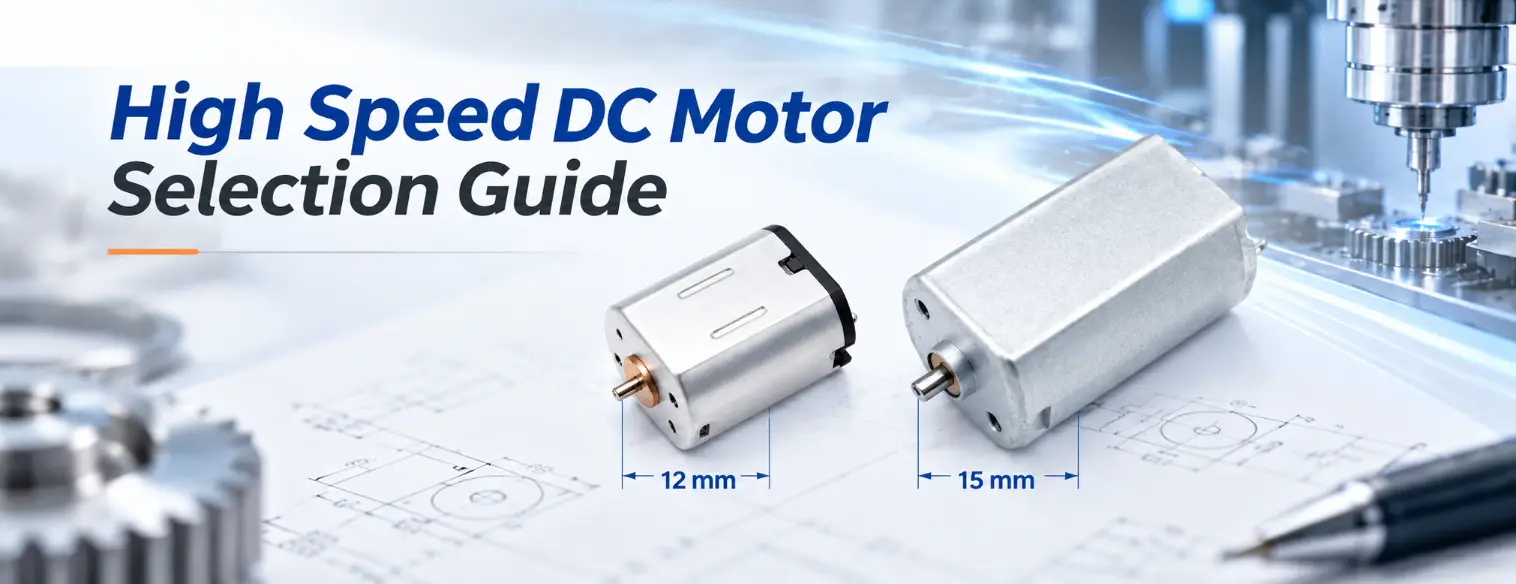
High speed DC motor selection should start with the required operating speed under load rather than the maximum no-load RPM shown in a specification sheet. A motor rated at 30,000 RPM may reach that speed without an external load, yet operate considerably slower once connected to a pump, rotating instrument or mechanical transmission. The resulting increase in current and temperature can also affect its suitability for extended operation. Engineers therefore need to examine the relationship between speed, torque, efficiency, electrical loading and mechanical construction before selecting a motor.
This guide explains how to interpret high-speed motor specifications, evaluate operating conditions and identify the technical information needed when comparing motors for industrial equipment and OEM applications.
1. Understand What High Speed DC Motor RPM Ratings Mean
A high speed DC motor is designed to operate at relatively high rotational speeds, but the term does not define a universal RPM threshold. Whether a motor is considered high-speed depends partly on its construction, dimensions and intended application. A speed suitable for one motor design may exceed the mechanical or thermal operating limits of another.
Engineers should distinguish between the rotational speed stated in a product specification and the speed that the motor can maintain when driving an actual mechanical load.
No-Load Speed vs. Operating Speed Under Load
No-load speed is the rotational speed measured when a motor operates at a specified supply voltage without an external mechanical load. The motor still consumes electrical energy to overcome internal friction, brush contact losses and other internal losses.
Rated-load speed describes the rotational speed at a manufacturer-defined rated operating condition. This condition should be accompanied by corresponding torque, voltage and current values. It should not be confused with the speed at maximum efficiency, which may occur at a different operating point.
Consider a motor driving a centrifugal pump. Its no-load speed is measured before the pump imposes its operating load. Once the impeller begins moving fluid, the required torque changes with the hydraulic operating conditions. The motor settles at a speed determined by the intersection of its torque-speed characteristic and the pump’s load characteristic.
For this reason, engineers evaluating a high speed DC motor should request performance data at the intended supply voltage rather than relying on a single maximum RPM figure.
What Do 20,000, 30,000 and 50,000 RPM Actually Mean?
Rotational speed figures such as 20,000, 30,000 and 50,000 RPM frequently appear in motor searches and product specifications. However, these figures have limited engineering value without information about the conditions under which they were measured.
A motor advertised at 50,000 RPM does not necessarily deliver more usable mechanical power than a motor advertised at 30,000 RPM. The comparison depends on available torque, operating efficiency, current consumption and the mechanical limitations of each design.
| Advertised Speed | What Engineers Should Verify | Engineering Consideration |
|---|---|---|
| 20,000 RPM | Operating speed and available torque | Whether the motor maintains the required speed under the application load |
| 30,000 RPM | Torque-speed curve and current consumption | Whether the intended operating point meets electrical and mechanical requirements |
| 50,000 RPM | Mechanical speed limit, temperature rise and operating duty | Whether the motor construction supports the required operating conditions |
These values are illustrative speed categories, not verified performance specifications for individual Kechen Motor products.
Supply voltage also requires attention. Increasing the applied voltage generally increases the no-load speed of a permanent-magnet brushed DC motor, but it can also increase current under certain loading conditions and exceed the motor’s electrical or mechanical limits. Engineers should use the manufacturer’s approved voltage range and verify performance under the intended operating conditions.

2. Check the High Speed DC Motor Torque-Speed Curve
The torque-speed curve provides information that an isolated RPM rating cannot. It describes the relationship between rotational speed and available output torque at a specified supply voltage. For conventional permanent-magnet brushed DC motors, speed typically decreases as torque increases.
This relationship is particularly important when selecting a high speed DC motor for equipment that must maintain rotational speed while experiencing changes in mechanical resistance.
How Load Torque Changes Motor Speed
When mechanical load increases, the motor must generate additional torque. In a brushed permanent-magnet DC motor, this generally requires additional armature current. The resulting increase in voltage drop across the winding resistance reduces the voltage available to generate back electromotive force, contributing to a reduction in rotational speed.
Under simplified conditions with constant magnetic flux and a stable supply voltage, the torque-speed relationship is approximately linear. Actual performance can differ because of temperature-dependent winding resistance, brush contact losses and other motor characteristics.
For example, a laboratory mixing mechanism may experience different mechanical resistance depending on the material being processed. A motor that achieves the target RPM under a light load may operate at a lower speed when the material becomes more viscous.
The relevant selection parameter is therefore the available torque at the required operating speed, not the maximum torque or maximum speed considered independently.
Startup conditions must also be evaluated. Some mechanisms require substantially more torque during acceleration than during steady operation. Engineers should identify both requirements and verify that the motor and its power supply can accommodate the resulting current demand.
Maximum Efficiency and the Actual Operating Point
Maximum efficiency identifies the operating condition at which the ratio of useful mechanical output power to electrical input power reaches its highest value under the specified test conditions.
For a rotating motor, mechanical output power is determined by output torque and angular velocity. Consequently, a motor operating at high RPM with very little available torque may produce less useful mechanical power than expected.
Maximum efficiency should not be confused with maximum mechanical output power. These operating points generally occur at different positions along the torque-speed curve.
Consider a high-speed rotating measurement assembly that operates for several hours during each production shift. Its motor should be evaluated at the speed and torque required by the assembly. Operating close to the maximum-efficiency region may reduce electrical losses, but the final operating point must also satisfy speed stability, startup and thermal requirements.
When comparing motor candidates, engineers should request torque-speed and efficiency data measured under comparable conditions. If only limited performance information is available, sample testing can establish whether the proposed motor meets the application’s requirements.
3. Evaluate Current Consumption and Temperature Rise
Electrical loading and thermal performance are closely related. A high speed DC motor may achieve its target rotational speed during a short test while developing excessive temperature during extended operation.
Current measurements provide an indication of the motor’s electrical loading, although current alone cannot establish the temperature that the motor will reach in a particular installation.
Three current measurements are especially relevant:
- No-load current: Current consumed when the motor operates without an external mechanical load at the specified voltage.
- Rated current: Current associated with the manufacturer’s defined rated operating condition.
- Stall current: Current drawn when the rotor is prevented from rotating under specified electrical conditions.
These values serve different purposes. No-load current provides information about unloaded operation, while rated current helps engineers evaluate the intended operating condition. Stall current is particularly relevant to startup, blocked-rotor conditions and power supply protection.
For example, a motor driving an industrial airflow mechanism may draw relatively little current during unloaded testing. Once connected to its intended fan assembly, the aerodynamic load changes its operating speed and current consumption.
Temperature rise is influenced by winding losses, mechanical friction, brush contact losses and the installation’s ability to dissipate heat. Winding resistance also changes with temperature, which can alter motor performance as operating conditions stabilize.
High speed DC motor temperature rise should therefore be evaluated at the actual operating voltage, load and duty cycle. Measurements taken in an open test fixture may not represent performance inside an enclosed instrument with restricted airflow.
Engineers should also consider supply voltage stability. Voltage reductions caused by inadequate power supply capacity or wiring losses can affect operating speed, particularly during startup and changes in mechanical load.
Acceptable temperature limits depend on the motor’s winding insulation, brush construction, bearing system and other design characteristics. These limits should be confirmed using the specifications of the selected motor rather than assumed from its physical dimensions.
4. Examine Bearings, Brush Wear and Mechanical Limits
Electrical performance is only one part of high-speed motor selection. The rotating assembly must also withstand the mechanical conditions associated with the required speed.
Bearing configuration, rotor balance, shaft loading and brush construction can influence vibration, operating noise and service life. Their importance generally increases as rotational speed and operating duration increase.
Bearings should be evaluated according to the expected rotational speed, radial load, axial load and installation conditions. A bearing arrangement suitable for a lightly loaded rotating instrument may not be appropriate for a mechanism that applies substantial radial force to the motor shaft.
Shaft alignment is another consideration. Misalignment between the motor and the driven mechanism can introduce additional bearing loads and vibration. Engineers should examine coupling geometry, shaft dimensions, mounting tolerances and the alignment requirements of the complete assembly.
In brushed DC motors, the brushes maintain electrical contact with the rotating commutator. Brush wear depends on several factors, including rotational speed, current, brush material, commutator construction and operating environment.
For example, a motor operating intermittently in a portable instrument may experience different wear conditions from an otherwise similar motor operating continuously in industrial equipment.
Higher rotational speed can also increase the importance of rotor balance. Excessive vibration may affect bearing loading, noise and the performance of connected mechanisms.
Engineers should avoid assuming that a motor can operate continuously at its advertised maximum RPM. The manufacturer should confirm the applicable mechanical speed limits and operating restrictions for the selected configuration.
Where service life is a critical design requirement, endurance testing should reproduce the intended speed, mechanical load, operating temperature and duty cycle.
5. Determine Whether the Motor Can Operate Continuously
High speed DC motor continuous operation requires more than reaching the specified RPM during initial testing. The motor must maintain acceptable electrical, thermal and mechanical conditions throughout the intended operating period.
Duty cycle describes the relationship between operating time and the complete operating cycle. However, the percentage alone does not fully describe the thermal conditions experienced by a motor.
For example, two applications may both have a 50% duty cycle. One operates for five seconds before resting for five seconds, while the other operates for thirty minutes before resting for thirty minutes. Their temperature profiles may differ considerably because of the different heating and cooling periods.
Continuous operation introduces additional considerations because the motor may approach a thermal equilibrium at which generated heat and dissipated heat become approximately equal.
If the resulting temperature exceeds the motor’s allowable limits, the operating conditions must be reconsidered. Possible engineering changes include reducing mechanical load, adjusting the operating speed, improving heat dissipation or selecting a different motor configuration.
Repeated acceleration also deserves attention. Applications involving frequent starts and stops can produce current peaks and thermal conditions that differ from steady-speed operation.
A laboratory instrument that runs for several minutes per measurement may therefore have different motor requirements from industrial equipment expected to operate throughout an entire production shift.
Before approving a motor for continuous operation, engineers should test the proposed assembly under representative mechanical loads, installation conditions and ambient temperatures. Temperature and current measurements should continue long enough to characterize the intended operating cycle.
6. Match High Speed DC Motor Specifications to Your Application
Motor selection becomes more reliable when application requirements are defined before comparing product specifications. Different mechanisms impose different torque, speed, installation and operating requirements, even when their nominal rotational speeds are similar.
A high speed DC motor used in a laboratory instrument may need to accommodate frequent starts and short operating periods. An industrial rotating mechanism may require longer operating intervals and experience variations in mechanical load.
Pumps and airflow mechanisms introduce another consideration: their load characteristics can change substantially with operating speed and system resistance. The motor should therefore be evaluated together with the actual driven mechanism.
Precision instruments may also impose restrictions on vibration, operating noise, shaft runout and installation dimensions. These requirements should be specified separately rather than inferred from the motor’s RPM rating.
| Application Requirement | Information to Specify | Reason for Evaluation |
|---|---|---|
| Operating speed | Required RPM under normal load | Establishes the intended operating point |
| Mechanical load | Operating torque and startup torque | Determines torque and current requirements |
| Electrical supply | Voltage range and available current | Establishes electrical compatibility |
| Operating schedule | Continuous or intermittent duty | Supports thermal evaluation |
| Mechanical interface | Shaft dimensions, mounting and applied loads | Supports mechanical integration |
| Installation environment | Ambient temperature and cooling conditions | Identifies operating restrictions |
Engineers should also establish which requirements are mandatory and which can be adjusted during development. This distinction is useful when evaluating alternative winding configurations, shaft designs or motor dimensions.
Where a standard product does not satisfy all requirements, an application-specific configuration may be considered, subject to engineering feasibility and sample validation.
7. High Speed DC Motor Selection Checklist for OEM Projects
A structured high speed DC motor selection process helps engineering and purchasing teams compare products using consistent technical requirements.
Before requesting samples or approving a motor configuration, engineers should verify the following information:
- Operating speed: Define the required RPM under the actual mechanical load rather than specifying maximum no-load speed alone.
- Torque requirements: Identify steady-state operating torque, startup torque and expected load variations.
- Electrical supply: Confirm the available voltage range, current capacity and relevant supply limitations.
- Performance characteristics: Request torque-speed data at the intended operating voltage.
- Operating efficiency: Evaluate the intended operating point relative to the motor’s efficiency characteristics.
- Thermal conditions: Establish acceptable temperature limits and representative cooling conditions.
- Mechanical construction: Review bearing configuration, brush construction, shaft loading and mounting requirements.
- Duty cycle: Specify operating duration, rest periods and startup frequency.
- Installation dimensions: Provide dimensional restrictions, shaft specifications and mechanical interface requirements.
- Sample validation: Test the selected configuration under representative application conditions before final approval.
Technical buyers should request comparable performance information from prospective suppliers. A specification containing only voltage and maximum RPM is generally insufficient for evaluating motors intended for demanding operating conditions.
For OEM projects, providing the application requirements early in the selection process can reduce the need to evaluate motor configurations that do not satisfy the intended operating conditions.
Discuss Your High Speed DC Motor Requirements
Kechen Motor supplies micro motors and OEM/ODM motor solutions for industrial equipment and other applications. Engineering discussions can cover operating speed, load torque, winding configuration, shaft requirements and application-specific customization, subject to technical feasibility.
Share your required operating RPM, torque, voltage, duty cycle and installation dimensions with Kechen Motor to discuss suitable motor configurations and sample evaluation.
Request a Custom Motor Solution
Frequently Asked Questions
Is a 30,000 RPM DC Motor Always Better
Than a 20,000 RPM Motor?
No. The higher RPM figure does not establish which motor is more suitable. Engineers must compare available torque at the required operating speed, current consumption, efficiency and mechanical operating limits. A motor with a lower no-load speed may satisfy an application’s load requirements more effectively than one with a higher advertised RPM.
Can a High Speed DC Motor Run Continuously?
Continuous operation depends on the motor configuration, operating load, supply voltage, temperature rise and cooling conditions. A motor that reaches its target RPM during a short test is not necessarily suitable for extended operation. Continuous-duty suitability should be confirmed through manufacturer specifications and application-specific thermal testing.
Why Does a High Speed DC Motor Slow Down
Under Load?
Increasing mechanical load requires additional output torque and generally increases armature current. In a conventional permanent-magnet brushed DC motor, the resulting voltage drop across the winding resistance contributes to reduced rotational speed. The actual speed reduction depends on the motor’s torque-speed characteristics, supply conditions and operating temperature.