

Micro Motor Blogs
Tech Insights: Key Advantages of Brushless vs Brushed Micro DC Motors Explained
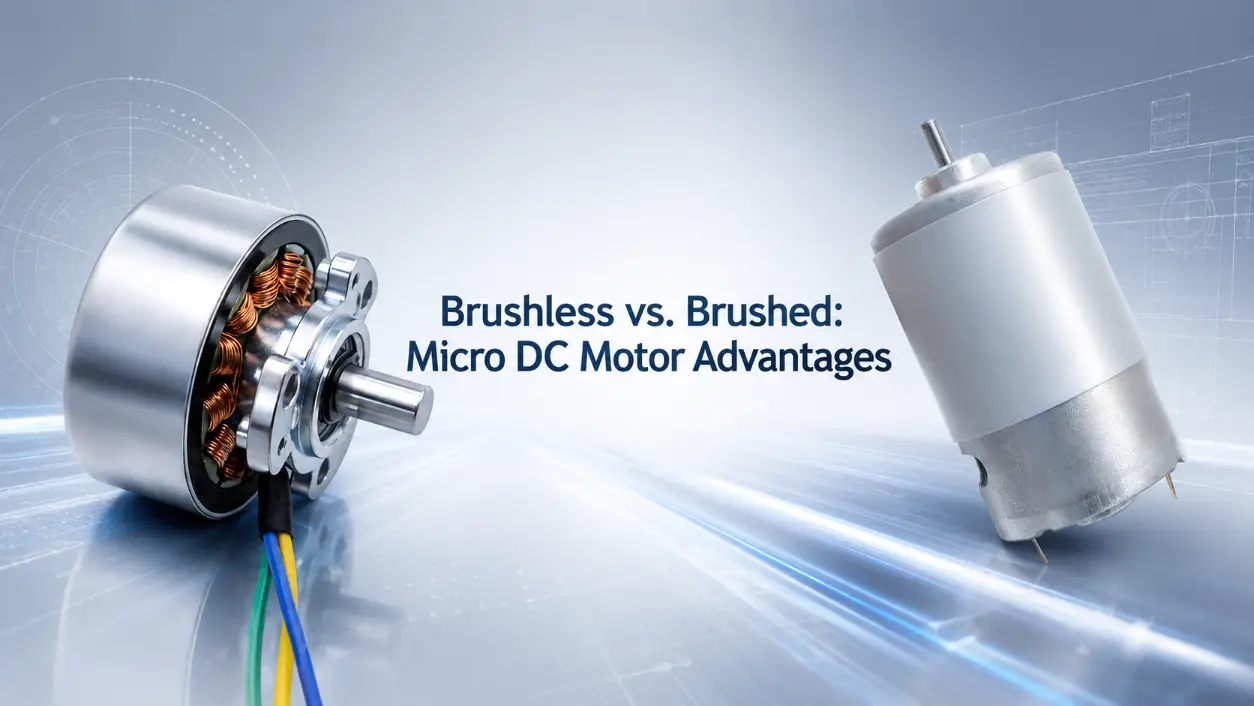
Micro DC motors serve as the foundational actuators in modern industrial instrumentation, consumer electronics, and precision automation. As engineers specify components for new hardware, the decision between traditional mechanical commutation and electronic commutation remains a primary technical consideration. Understanding the fundamental advantages of brushless vs brushed micro DC motors is essential for balancing operational longevity, integration complexity, and total cost of ownership. This article evaluates the electromechanical differences between these architectures to assist design teams in selecting the correct power transmission solution for specific duty cycles and environmental constraints.
Operating Principles of Brushed Micro DC Motors
The brushed micro DC motor remains a baseline architecture due to its mechanical simplicity. The design utilizes a physical interface where carbon or metal brushes maintain sliding contact with a rotating commutator. This mechanical connection facilitates the reversal of current flow through the armature windings as the rotor turns, maintaining torque in a single direction.
The primary engineering appeal of this design lies in its inherent ease of control. By applying a constant DC voltage, the motor initiates motion, requiring only simple pulse-width modulation (PWM) for speed regulation without the need for complex feedback loops or external electronic drivers. However, the physical contact between brushes and the commutator introduces significant operational limitations. Friction results in material wear, can generate debris over time, and produces audible noise and electrical arcing. Consequently, these motors are generally suited for applications where lower upfront investment is the priority and the operational lifecycle is relatively short or intermittent, such as basic consumer appliances or low-cost disposable electronics.
The Technical Edge of Brushless Micro DC Motors
Brushless micro DC motors (BLDC) replace mechanical brushes with an electronic commutation system, utilizing Hall effect sensors or back‑electromotive force (BEMF) sensing to determine rotor position. By switching current through stationary stator coils via an external controller, the rotor—which houses permanent magnets—is driven by a rotating magnetic field.
This transition from mechanical to electronic switching yields distinct performance advantages:
- Extended Operational Longevity: Eliminating the physical brush‑commutator interface removes the primary mechanical wear point. The remaining wearing components are the ball bearings, though the electronic controller itself represents a potential system‑level failure point that requires robust design. This architecture allows significantly longer service intervals compared to brushed variants.
- Efficiency: Without friction losses from brushes and arcing at the commutator, these motors convert a higher percentage of electrical input into mechanical output, resulting in cooler operation under sustained loads. Typical efficiencies exceed 80%, compared to roughly 60% for brushed motors.
- Reduced Acoustic Signature: The absence of physical sliding contact eliminates the mechanical noise and electrical arcing commonly associated with brush operation, providing a quieter profile for sensitive equipment.
- High Power Density: With windings located on the stator, heat dissipation is more effective through the motor housing. Moreover, electronic commutation enables higher rotational speeds and greater current capacity, allowing more continuous power output within a compact form factor.
These characteristics make BLDC motors the standard for applications demanding precision, high rotational speeds, and reliable operation in inaccessible environments, such as aerospace actuators and surgical robotics.
Technical Comparison Matrix
The following table summarizes the operational trade‑offs between the two architectures to facilitate engineering decision‑making.
| Parameter | Brushed | Brushless |
|---|---|---|
| Efficiency | ~60% | >80% |
| Operational Lifespan | Short / Intermittent | Long / Continuous |
| Noise Level | Higher (mechanical & arcing) | Quieter |
| Power Density | Moderate | Higher |
| Cost (per unit) | Lower | Higher |
| Control Complexity | Simple (direct PWM) | Complex (requires controller) |
Engineering Selection Criteria
Determining how to choose a custom micro DC motor requires a rigorous review of system requirements. Engineers should refer to a custom micro DC motor design guide for engineers to map specific load profiles against motor performance curves.
Key factors include the required torque‑speed curve, environmental temperature, and vibration sensitivity. In many instances, off‑the‑shelf components lack the necessary mounting flange or shaft geometry; therefore, partnering with an experienced custom micro DC motor manufacturer ensures the drive train matches the mechanical housing of the device. When identifying an OEM miniature DC motor supplier, verify their capability to provide technical documentation and sample sets for prototype testing. For volume requirements, sourcing via a professional wholesale custom small DC motors provider offers a stable supply chain, provided they can support specific voltage and torque modifications tailored to the application. For projects requiring integrated motion, knowing where to buy customized miniature gear motors involves evaluating the vendor’s capability to integrate spur or planetary gearboxes that meet specific torque multiplication requirements without compromising the motor’s rated efficiency.
Industry Implementation Examples
Brushed motors remain the practical choice for cost‑sensitive, non‑critical systems, including small handheld household tools, low‑cycle office equipment, and basic educational robotics. Conversely, brushless technology is the mandatory selection for performance‑critical systems such as high‑altitude drone propulsion, infusion pumps in medical settings, and precision industrial positioning actuators where downtime represents a significant financial risk.
Conclusion
While the transition to brushless architecture provides superior efficiency and durability for high‑performance applications, brushed motors maintain essential utility in cost‑constrained environments where mechanical simplicity is preferred.
Frequently Asked Questions
No. While brushless motors offer better efficiency and longevity, they require an external controller and complex wiring, which increases system costs and integration difficulty. If your application requires a simple, low‑cost “plug‑and‑play” solution, a brushed motor is often the more suitable technical choice.
Not necessarily. While sensored BLDC motors provide precise starting torque and low‑speed control, sensorless designs—which derive rotor position from back‑EMF—are widely used in applications where high starting torque is not critical, such as cooling fans or centrifugal pumps. However, sensorless operation cannot generate back‑EMF at standstill, requiring special start‑up routines and offering limited low‑speed performance; designers must account for these constraints when selecting this approach.