

Micro Motor Blogs
Comparing Micro DC Motor Manufacturers: Why the Lowest Quote Is Almost Never the Best Value
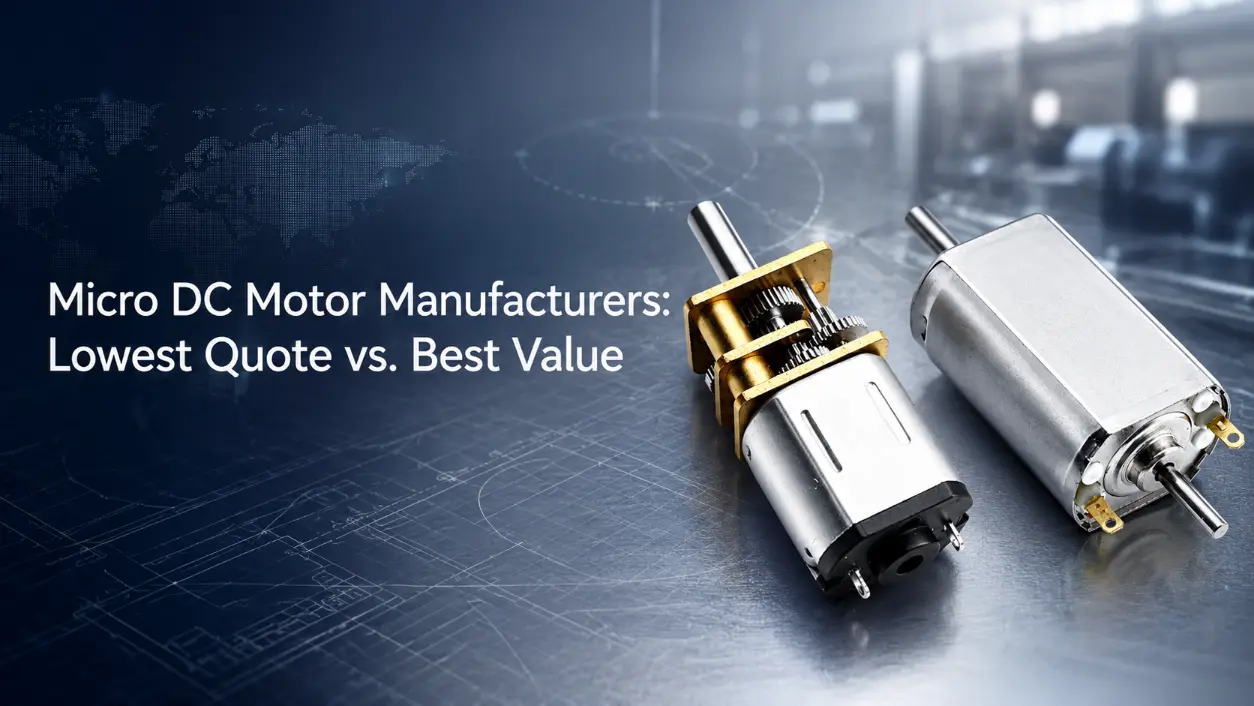
Procurement teams often face intense pressure to trim bill-of-materials (BOM) expenses in multi-axis automation design. When evaluating multiple micro dc motor manufacturers, the immediate instinct is frequently to select the vendor offering the lowest unit quotation. However, in precision industrial applications, an upfront cost reduction often masks severe long-term engineering deficits. Sub-optimal components compromise system reliability, accelerate mechanical wear, and generate catastrophic operational downtime. Understanding the true total cost of ownership (TCO) requires a rigorous examination of material selection, manufacturing tolerances, and quality verification protocols — factors that are widely recognised in the industry as dominating long-term operational expenses.
II. The Hidden Costs of the Lowest Bid
When pricing drops significantly below market baseline, it usually signals severe compromise in material composition and manufacturing execution. Low-cost suppliers frequently substitute high-grade neodymium-iron-boron (NdFeB) permanent magnets with lower-cost ferrite or low-remanence alloys. While ferrite itself is not inherently substandard, its magnetic flux density and output torque are substantially inferior — typically only 30–60% of NdFeB under the same volume — and the performance gap widens under thermal load. Similarly, commutator brushes made from copper-graphite blends of inconsistent quality may suffer from accelerated electrical arcing and rapid carbon buildup, contributing to premature motor failure, though the precise causal chain depends on specific material formulations and operating conditions.
Furthermore, inconsistent copper wire winding tension can create internal electrical resistance anomalies. This may lead to localized overheating, thermal insulation breakdown, and erratic current draws during start-up cycles. While direct empirical evidence linking winding tension alone to brush wear is limited, engineering principles suggest that asymmetrical resistance increases local current density and heat generation, which in turn accelerates insulation ageing and commutator degradation. When procurement networks rely on a cheap wholesale micro dc motor sourced without strict factory traceability, batch variance spikes. If an assembly line experiences a high failure rate due to intermittent rotor binding or bearing misalignment, the financial burden of line stoppages, warranty claims, and field replacements far outweighs any initial unit-price savings.
III. Critical Criteria for Evaluating a Micro DC Motor Manufacturer
Mitigating supply chain risk demands a systematic auditing framework. Qualified small electric motor manufacturers must demonstrate adherence to international quality management systems, such as ISO 9001 for general manufacturing and ISO 13485 for medical-device applications, ensuring process repeatability across high-volume production lines. Engineering teams must evaluate a prospective micro dc motor manufacturers based on specific technical parameters — such as torque-speed curves, thermal resistance, and dielectric strength — rather than generic marketing claims.
Evaluating gear reduction performance is equally crucial. For example, in automated medical dispensing pumps or optical positioning gimbals, mechanical backlash must be minimized. A certified supplier ensures that planetary or spur gear configurations maintain low backlash angles (often below 1.5° or even 1°) and high load-carrying capacity under continuous operational profiles, as verified by industry-standard testing.
IV. Sourcing Realities and Global Technical Alignment
Navigating international industrial supply chains requires aligning mechanical requirements with regional manufacturing ecosystems. Partnering with a specialized china micro dc motor producer offers substantial scalability advantages, provided that technical communications explicitly detail operating parameters such as stall torque, no-load speed, and thermal resistance coefficients. Many Chinese manufacturers hold ISO 9001 certification and have extensive experience in high-mix, low-volume production, making them viable partners when technical specifications are clearly defined.
For applications requiring high torque density within a confined rotational layout, collaborating directly with an experienced china dc gear motor manufacturer ensures proper module sizing, gear material hardening, and lubrication stability across wide temperature ranges (-20°C to +85°C) — a range that is conservative and well within common industrial specifications (many products are rated from -40°C to +100°C). Conversely, when engineers develop restricted-envelope systems — such as automated fluid valves or handheld diagnostic instruments — specifying a durable small electric dc motor requires careful calculation of duty cycles to prevent thermal saturation of the armature windings.
V. Value Integration and Technical Verification
Long-term component reliability relies on rigorous validation protocols. Procurement managers must require comprehensive torque-speed curves, efficiency mapping, and noise-vibration-harshness (NVH) testing reports prior to mass production release. On-site factory auditing, including accelerated life testing chambers and dynamic balancing verification, guarantees that the integrated drive system meets the target operational lifespan. Prioritizing transparent engineering communication over short-term financial savings secures the structural integrity of the final mechanical assembly.
VI. Conclusion & Technical FAQ
True component value is defined by operational longevity, thermal stability, and consistent mechanical output under load rather than the lowest initial purchase price. The industry consensus on TCO — where initial cost accounts for only 5–10% of lifetime expenses — reinforces the need for a holistic evaluation that balances engineering performance with supply-chain reliability.
Frequently Asked Questions
How does winding tension affect the operational life of brushed DC motors?
Inconsistent winding tension during automated armature winding can create asymmetrical electrical resistance across coils. This imbalance may accelerate localized brush wear, increase electromagnetic interference, and contribute to premature thermal degradation — though the extent depends on the overall motor design and operating environment. Empirical validation through life testing is recommended to confirm specific effects.
What is the primary indicator of substandard permanent magnets in motor production?
A rapid drop in output torque under nominal thermal load indicates low coercive force and thermal demagnetization, typically caused by inadequate magnetic alloy composition. While ferrite magnets are not inherently substandard, their lower performance compared to NdFeB should be factored into the torque-density requirements of the application.