

Micro Motor Blogs
Why Selecting the Right Micro DC Motor for Medical Devices is Critical to Patient Safety
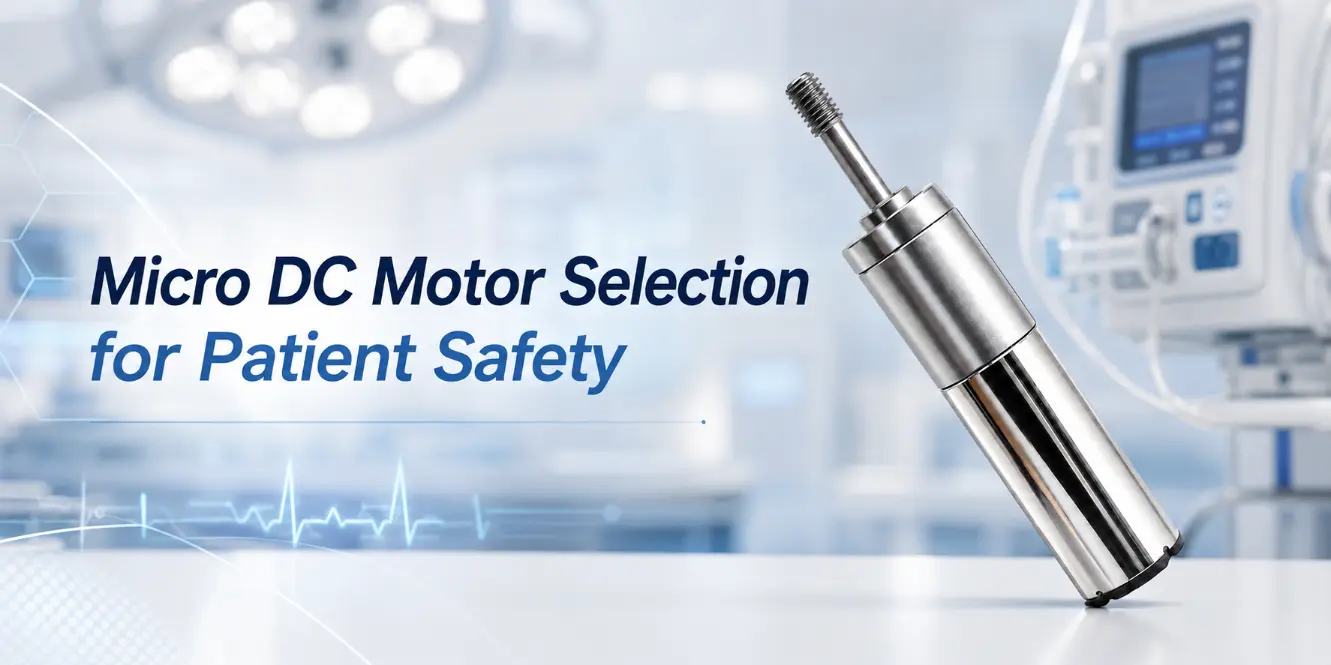
In medical device engineering, selecting the right micro DC motor for medical devices directly affects patient outcomes and device reliability. Whether used in infusion pumps, surgical tools, or diagnostic imaging, the motor acts as the mechanical core. This article serves as a practical custom micro DC motor design guide for engineers, covering everything from torque‑speed curves to supply chain strategy. Engineers and procurement managers must balance high performance with regulatory standards. But knowing how to choose a custom micro DC motor involves more than just reading datasheets; it demands a holistic view of the clinical environment and mechanical constraints.
Operational Realities of Medical Motor Performance
The environment for medical electronics is demanding. Unlike industrial automation, a minor deviation can have immediate physiological consequences. When sourcing a high speed low noise micro DC motor, engineers must carefully evaluate vibration, electromagnetic interference (EMI), and thermal behavior. These factors are critical in applications like automated titration, where sensor feedback must remain stable. A quiet motor with balanced rotors and high‑quality bearings—often a hallmark of top‑tier custom micro DC motor manufacturer—reduces instability without sacrificing speed or power density.
Thermal performance is equally vital. Operating a motor outside its efficient range generates excess heat, forcing designers to add bulky cooling. This is where consulting a detailed custom micro DC motor design guide for engineers pays off, as it helps match the efficiency curve to the duty cycle, ensuring both safety and compactness for patient‑contact devices.
Engineering Criteria: Selection and Integration
Understanding how to choose a custom micro DC motor starts with a disciplined evaluation of torque, speed, and load. The table below outlines key parameters that guide the decision process, whether you’re prototyping or scaling to mass production.
| Parameter | Typical Range | Impact on Medical Device |
|---|---|---|
| Supply Voltage | 3–24 V DC | Determines power source compatibility and battery life |
| No‑Load Speed | 1 000 – 30 000 rpm | Affects output speed and gearing requirements |
| Rated Torque | 1 – 100 mNm (often with gearbox) | Defines load capacity for fluid pumping or actuation |
| Noise Level | Typically < 40 dB(A) at 1 m | Influences patient comfort and acoustic environment |
| Expected Lifetime | > 5 000 hours (continuous) | Directly relates to device service life and maintenance |
| EMI Signature | Varies with commutation | Affects signal integrity in sensitive sensors |
These values serve as a baseline. For specialized needs, working with a reliable OEM miniature DC motor supplier ensures you get custom windings, shaft modifications, or integrated encoders. Additionally, a bespoke micro DC motor factory China can offer cost‑effective solutions without compromising on cleanroom assembly standards—provided they share comprehensive test data and FMEA documentation.
A critical choice is between brushed and brushless designs. While brushed motors are cost‑effective, brushless variants offer cleaner operation and longer life. The selection should be guided by the specific clinical risk tolerance, rather than generic assumptions.
Building a Reliable Supply Chain
Transitioning from prototype to serial production demands collaboration with a custom micro DC motor manufacturer that understands ISO 13485 and FDA guidelines. A top‑tier OEM miniature DC motor supplier provides full material declarations, lot traceability, and sterilization validation (autoclave/EtO). While a bespoke micro DC motor factory China can offer excellent custom geometries and rapid prototyping, the deciding factor must always be their quality management system and engineering support, not just the price tag.
Capable suppliers will also help you navigate the nuances of how to choose a custom micro DC motor for sterile environments, verifying that insulation materials and lubricants withstand aggressive cycles without outgassing. This rigorous validation is the foundation of long‑term device safety.
Conclusion
Selecting a micro DC motor for medical devices is a multidimensional engineering decision. By leveraging a detailed custom micro DC motor design guide for engineers and working with an established OEM miniature DC motor supplier—or a trusted bespoke micro DC motor factory China—engineers can ensure precision, reliability, and patient safety. Always let verifiable data, rather than sweeping statements, guide your final decision.
Frequently Asked Questions
Industrial motors are designed for environments where periodic maintenance is expected. Medical devices, however, must endure repeated autoclaving or EtO gas exposure. Standard insulation degrades, while medical‑grade variants—often produced by a trusted OEM miniature DC motor supplier—use validated magnet wires and encapsulants to ensure electrical safety and biocompatibility.
EMI mitigation employs a multi‑layer strategy: shielded cables, ferrite beads, and optimized winding geometries. Advanced drive electronics with smooth commutation further reduce high‑frequency noise. When you source a high speed low noise micro DC motor from a reputable custom micro DC motor manufacturer, they often provide EMC test data to help you meet IEC 60601‑1‑2 compliance.