

Micro Motor Blogs
Lead Screw Stepper Motor vs. Belt Drive: Boosting Precision in Mini Linear Actuator Systems
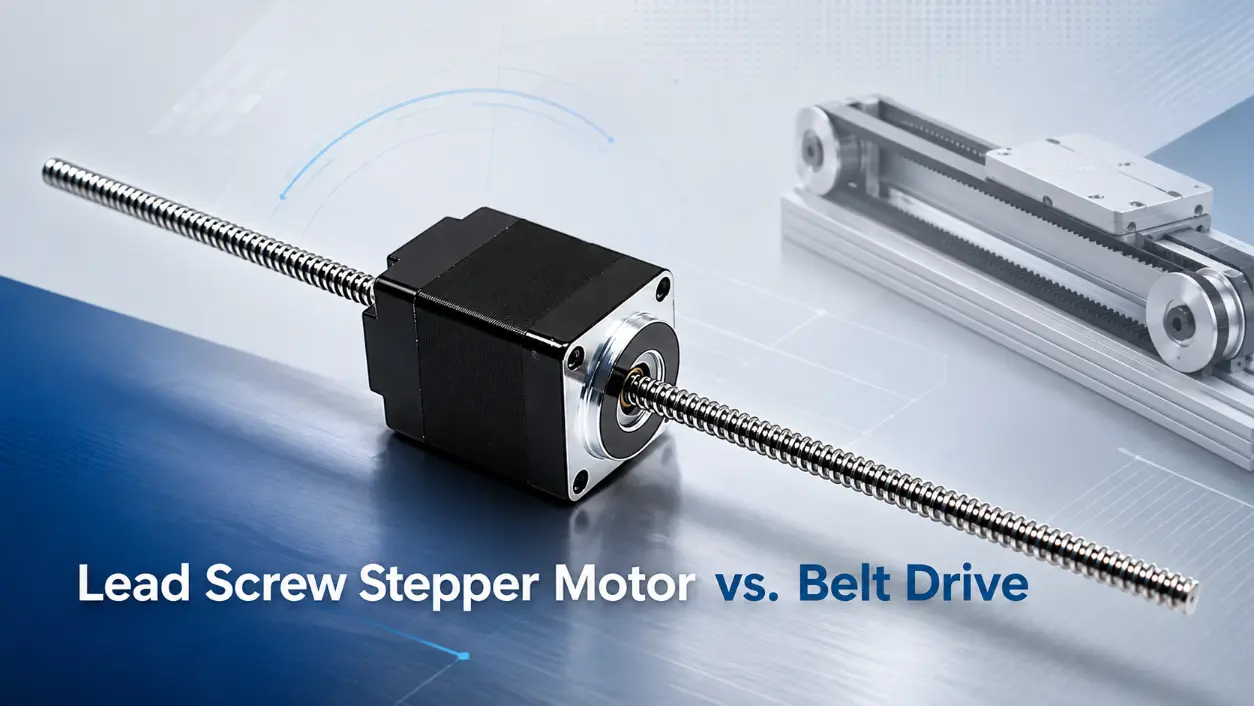
Modern precision engineering demands exceptional motion control within restricted spatial envelopes, frequently observed in automated liquid handling systems and optical focus modules. Designing a reliable lead screw stepper motor system for a mini linear actuator presents mechanical engineers with a persistent trade-off: selecting between a direct-coupled leadscrew assembly and a flexible belt transmission. This mechanical choice dictates the ultimate positioning accuracy, repeatability, and load capacity of the subassembly. For instance, in a PCR thermal cycler optical scanner, a micro-positioning error of even twenty micrometers can corrupt fluorescence detection readings. Consequently, understanding how a lead screw stepper motor transforms discrete electromagnetic pulses into linear displacement is vital for engineers designing high-reliability automation platforms.
Core Technologies Breakdown
Lead Screw Assemblies and Direct Conversion
Lead screw mechanisms operate by converting rotational input into linear displacement through the mechanical advantage of inclined planes wrapped around a cylinder. When integrated directly into a lead screw stepper motor, the rotor’s internal threading engages with a matching threaded shaft, eliminating intermediate couplings such as gears or pulleys. This direct-drive architecture minimizes mechanical compliance and backlash. In miniature automation systems, configurations like the stepper motor with screw shaft provide an optimized footprint for space-constrained assemblies, such as portable diagnostic blood analyzers where interior volume is strictly limited. The pitch of the thread determines the linear travel distance per motor revolution, allowing engineers to achieve sub-micron resolution without relying on complex multi-stage reduction gearboxes.
Belt Drive Configurations and Friction Dynamics
In contrast, belt drive systems rely on elastomeric timing belts and toothed pulleys to transmit motion across longer distances. While effective for high-speed lateral translation—such as in pick-and-place gantry systems—belts introduce inherent compliance due to material elasticity. Under rapid acceleration profiles, the belt stretches slightly, introducing hysteresis into the positioning loop. Furthermore, tensioning requirements place additional radial loads on motor bearings, necessitating more robust support structures. In industrial inkjet printers, where rapid carriage return is prioritized over absolute micron-level stationarity, belt drives are frequently deployed; however, they require periodic tension adjustment to compensate for thermal expansion and material creep over extended operational lifespans.
Precision, Backlash, and Load Performance
Positioning Accuracy and Backlash Characteristics
Positioning accuracy represents a critical metric when evaluating linear motion subassemblies. Lead screw stepper motor mechanisms inherently restrict axial play, provided that anti-backlash nuts are incorporated into the design. Because the thread engagement offers a high mechanical advantage, slip is virtually eliminated. When utilizing high-resolution micro-stepping drivers, a lead screw stepper motor can reliably position optical lenses in laser micromachining tools with repeatability ratings under five micrometers. Conversely, belt drives are susceptible to tooth jump under sudden torque spikes and elastic elongation during heavy load reversals, making them less suitable for applications requiring absolute rigid stationarity under load.
Force and Torque Transmission
Load capacity and thrust force vary significantly between these two transmission methodologies. A nema 8 stepper motor with lead screw delivers remarkable axial thrust relative to its diminutive frame size, making it the preferred choice for micro-valve actuation in fluidic manifolds and needle insertion mechanisms in medical laboratory automation. The fine thread pitch multiplies the holding torque of the electromagnetic rotor into substantial linear force. Miniature belt drives, while capable of high linear velocities, experience severe capacity limitations when subjected to vertical payloads due to the risk of slip and the lack of self-locking characteristics inherent in most lead screw profiles.
Operational Speed, Wear, and Environmental Factors
Velocity versus Resolution Trade-offs
The operational profile of an automated machine dictates the choice between high speed and high resolution. Belt drives excel in high-speed, long-stroke scenarios where linear velocities can exceed one meter per second, such as in automated optical inspection (AOI) scanners. Conversely, lead screw configurations prioritize controlled, high-resolution feed rates over raw velocity. Operating a fine-pitched lead screw stepper motor at excessive rotational speeds generates substantial frictional heat within the nut interface, accelerating thermal expansion and degrading positional accuracy. Therefore, applications requiring rapid traversal over long distances typically favor belts, whereas short-stroke, high-precision dispensing systems rely on lead screws.
Maintenance Cycles and Environmental Resilience
Mechanical wear patterns differ fundamentally between the two systems. Lead screws experience sliding friction between the male threads and the internal nut, necessitating proper lubrication—such as specialized engineering fluoropolymer coatings or dry lubricants—to prevent galling and premature thread degradation over millions of cycles. In cleanroom environments, where particle generation must be minimized, lead screws utilizing specialized self-lubricating engineering plastics provide superior contamination control compared to shedding elastomeric belts. Furthermore, environmental resilience against dust and particulate ingress is naturally higher in enclosed lead screw assemblies than in open-path timing belt tracks.
Engineering Selection Matrix
When finalizing the bill of materials for a new automated device, engineers must systematically evaluate operational constraints. The following static HTML table outlines the fundamental technical trade-offs between the two transmission technologies.
| Performance Metric | Lead Screw Stepper Motor | Belt Drive System |
|---|---|---|
| Positional Resolution | Sub-micron to micron level | Sub-millimeter to millimeter |
| Backlash & Compliance | Minimal (eliminates slip) | Moderate to high (elastic stretch) |
| Max Linear Velocity | Low to moderate | High |
| Axial Thrust Force | High (amplified by mechanical advantage) | Limited by belt tension and friction |
| Vertical Load Capacity | Excellent (self-locking properties) | Poor (requires external braking) |
Selecting the appropriate motion transmission mechanism directly determines the mechanical stability, positioning accuracy, and long-term reliability of precision automation equipment.