

Micro Motor Blogs
How to Choose a Reliable Custom Micro DC Motor Manufacturer for Your Project
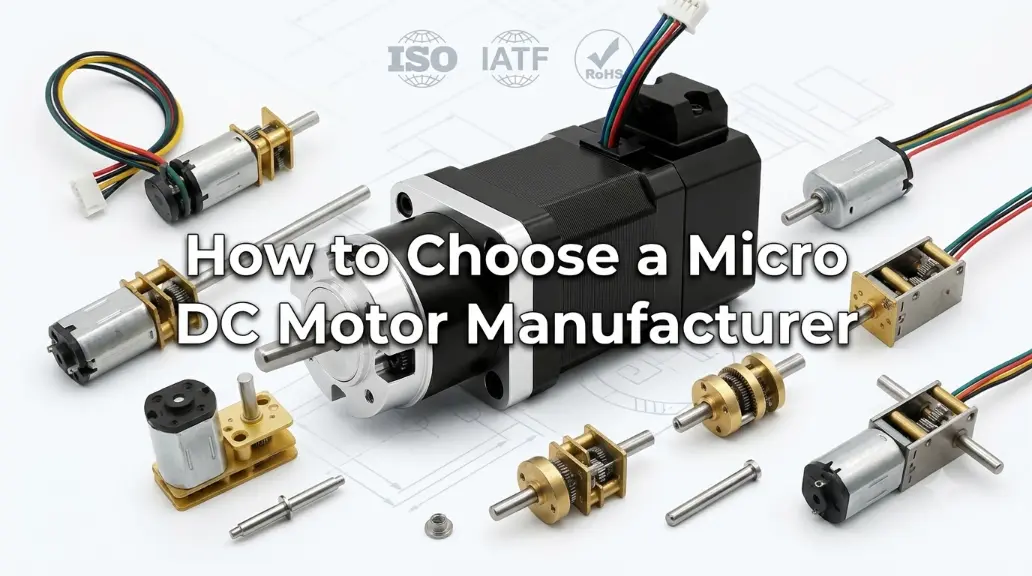
Selecting a custom micro DC motor manufacturer for a medical device, robotic actuator, or automotive subsystem requires more than comparing datasheet specs. The wrong supplier introduces variability in torque linearity, thermal drift, and long-term reliability—failure modes that often surface only after thousands of operating cycles. Engineering teams and procurement managers must evaluate technical capability, quality systems, and supply chain discipline against application-specific constraints before committing to production tooling.
Define Your Application Parameters Before Engaging a Supplier
Motor selection begins with a complete specification of the operating envelope. Voltage range, duty cycle, ambient temperature, and available mounting envelope determine which motor technologies are viable. A custom micro DC motor manufacturer cannot provide meaningful design recommendations without these inputs.
Electrical and Mechanical Specifications
Rated voltage defines the motor’s nominal operating point. Common industrial voltages include 3V, 6V, 12V, and 24V. A custom 12V micro brushed DC motor intended for automotive actuators must maintain torque output across the full battery voltage range—typically 9V to 16V in 12V systems. Operating the motor above rated voltage accelerates brush wear and insulation breakdown; below rated voltage, torque drops proportionally.
Speed and torque requirements are interdependent. No-load speed indicates the maximum rotational velocity without external load; load speed under applied torque is the more practical design parameter. For a miniature DC gear motor for smart locks, the gearbox reduction ratio transforms a high-speed, low-torque motor into a low-speed, high-torque output suitable for bolt actuation. Planetary gearboxes offer better torque efficiency than spur gears in compact form factors.
Current draw directly impacts power supply sizing and thermal management. Stall current typically ranges from three to five times the rated current. Driver circuits must accommodate this peak without voltage sag or overcurrent protection tripping.
Environmental and Packaging Constraints
IP ratings specify ingress protection against solids and liquids. A miniature water resistant DC motor for beauty tools operating in humid environments may require IP54 or higher. For submersible applications, IP68‑rated motors with epoxy‑sealed housings and potted cable entries are specified.
Dimensional constraints often drive the choice between motor types. The smallest commercially available brushed micro motors measure 3 mm in diameter and produce torque below 0.1 mNm. Brushless DC (BLDC) types are available from 4 mm in precision series, with 6 mm being a common practical starting point for high‑volume production.
An ultra small coreless DC motor custom shaft configuration suits applications requiring rapid acceleration and low rotor inertia, such as precision positioning stages or handheld surgical tools. Coreless motors eliminate the iron armature, reducing inductance and enabling faster dynamic response.
Evaluate Manufacturer Capability Across Technical and Operational Dimensions
Supplier selection requires verification of technical depth, quality systems, and production scalability. A reliable custom micro DC motor manufacturer demonstrates competence across each of these areas.
Certification and Quality Management Systems
Industry‑specific certifications provide objective evidence of process control. ISO 9001 is the baseline quality management standard. IATF 16949 is required for automotive‑grade components. ISO 13485 applies to medical device manufacturers. Suppliers serving regulated industries should maintain these certifications and provide audit documentation upon request.
Beyond certification, request historical quality performance data—field return rates, first‑pass yield, and corrective action response times. Consistent process capability is indicated by low defect rates and robust failure analysis procedures. On‑time delivery records and customer audit results offer additional insight into operational discipline.
Customization Depth and Engineering Support
Customization extends beyond shaft diameter and lead wire length. A bespoke micro DC motor factory China should offer modifications to winding configurations, magnet materials, bearing types, and housing geometry. Full custom development—designing the gearbox and motor housing from the ground up—addresses unique geometrical constraints.
Engineering support during the design phase is critical. Suppliers with in‑house applications engineering can assist with torque‑speed curve analysis, thermal modeling, and electromagnetic compatibility testing. Request CAD models in IGS or STP format to verify mechanical integration before prototyping.
Supply Chain Verification and Production Scalability
Verify whether the supplier is a direct manufacturer or a trading company. Direct manufacturers typically offer better quality control, faster communication, and greater customization flexibility. Facility size and production line count indicate investment in vertical integration. An OEM miniature DC motor supplier should demonstrate capability to scale from prototype quantities to full production runs exceeding 50,000 units per month.
Prototype delivery typically ranges from one to four weeks, depending on the complexity of modifications—simple shaft or lead‑wire changes complete faster than full winding or housing redesign. For wholesale custom small DC motors, confirm MOQ flexibility and pricing tiers across volume breaks. Sample testing under real‑world load conditions—measuring torque consistency, noise levels, and temperature rise—validates supplier claims before volume commitment.
Compare Motor Technologies for Your Application
The choice between brushed and brushless motors affects cost, lifespan, and control complexity. Understanding the advantages of brushless vs brushed micro DC motors guides the selection process.
| Characteristic | Brushed DC Motor | Brushless DC Motor (BLDC) |
|---|---|---|
| Commutation | Mechanical (brushes and commutator) | Electronic (controller‑driven) |
| Lifespan | Limited by brush wear (thousands of hours) | Limited by bearing life (tens of thousands of hours) |
| Efficiency | Lower due to brush friction and arcing | Higher, with cooler operation |
| Control | Simple DC voltage control | Requires electronic commutation and position sensing |
| Cost | Lower initial cost | Higher due to controller and sensors |
Brushed motors remain attractive for cost‑sensitive, low‑duty‑cycle applications where simplicity and low‑voltage compatibility are priorities. Brushless motors excel in continuous operation, high‑speed applications, and environments where maintenance access is limited. For a custom micro brushless motor for drones, the efficiency advantage translates directly to extended flight time.
A small high torque DC motor for robotics may use a brushed or brushless design depending on the control requirements. If variable speed and precise position control are needed, BLDC motors with encoders are preferred. If simple ON/OFF control suffices, brushed motors offer better cost‑effectiveness.
Application‑Specific Considerations
Different end‑use sectors impose distinct requirements on motor design and manufacturing processes.
For a micro DC motor for medical devices, reliability and biocompatibility are paramount. Motors used in infusion pumps, surgical robots, and drug delivery systems must meet ISO 13485 requirements and demonstrate consistent performance across the product lifecycle. Coreless DC motors suit medical applications where dynamic response and low inertia are critical, such as robotic end‑effectors. Battery‑powered biomedical systems impose stringent efficiency constraints due to limited energy budgets.
For automotive actuators, IATF 16949 certification is non‑negotiable. Motors must withstand temperature extremes, vibration, and humidity while maintaining consistent torque output over the vehicle’s service life. A custom micro electric motor for automotive actuators typically requires extended endurance testing—5,000+ hour life cycles under load.
For consumer and industrial applications such as smart locks, beauty tools, and robotics, balancing cost, performance, and lead time drives the selection process. A miniature DC gear motor for smart locks requires high starting torque to overcome static friction, low noise for residential environments, and sufficient torque margin for reliable operation.
Practical Selection Framework
The how to choose a custom micro DC motor decision process follows a structured workflow:
- Define the operating envelope: voltage, current, speed, torque, duty cycle, ambient temperature, and IP rating.
- Select motor technology: brushed vs. brushless, coreless vs. iron‑core, with or without gearbox.
- Identify customization requirements: shaft geometry, lead length, connector type, mounting pattern.
- Evaluate suppliers: verify certifications, request samples, review engineering support capabilities.
- Test under load: validate torque‑speed curves, thermal performance, and acoustic noise against specifications.
- Confirm production readiness: MOQ, lead time, quality control documentation, and supply chain redundancy.
A custom micro DC motor design guide for engineers emphasizes margin—always add 20–30% safety margin on torque and consider temperature rise under worst‑case operating conditions. Selecting an underpowered motor leads to stalling or burnout; selecting an overpowered motor increases cost and weight unnecessarily.
Conclusion
Selecting a reliable custom micro DC motor manufacturer requires rigorous technical specification, systematic supplier evaluation, and application‑specific validation—the supplier’s engineering capability and quality systems determine whether the motor meets performance targets over its intended service life.